
In the last few hours, social media and the halls of Washington have erupted following the tense exchange at the White House Commission on Religious Liberty. Watching Carrie Prejean Boller be interrupted and pressured by Texas Lieutenant Governor Dan Patrick simply for stating a basic theological truth is not only outrageous, but revealing. By saying “I am a Catholic and Catholics do not embrace Zionism,” Carrie was not just defending herself; she was defending the coherence of our faith.
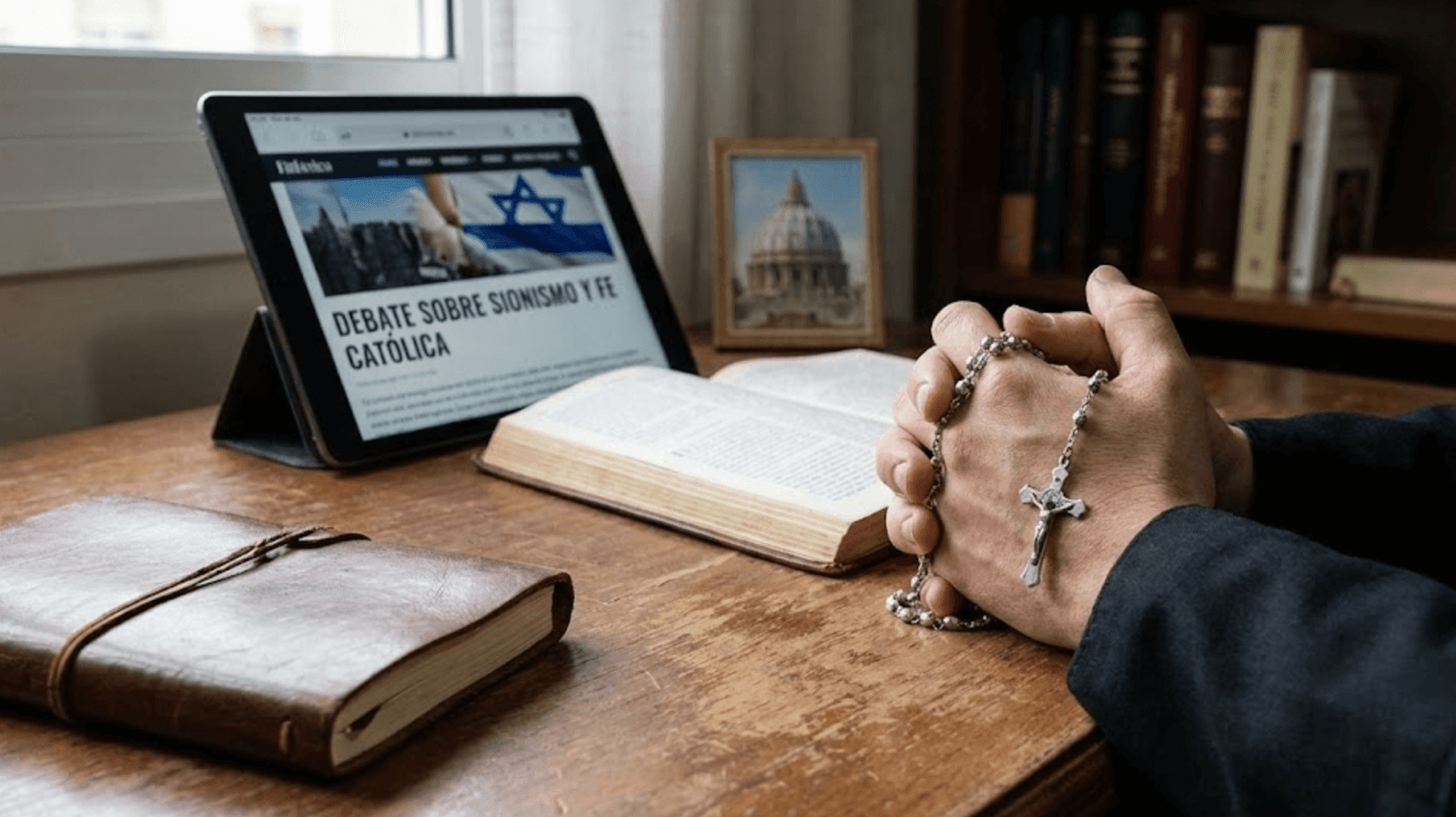
As a Catholic, today I say loud and clear: I stand with Carrie. And I stand with her because the Church, in her two thousand years of wisdom, has taught us to distinguish between faith and political ideology, between Biblical Israel and the modern State of 1948.
Zionism is Not a Dogma of Faith
The prevailing confusion, driven largely by “Christian Zionism” of an Evangelical-Protestant nature, attempts to equate support for the State of Israel with faithfulness to God. For a Catholic, this is a grave theological error.
The Magisterium of the Church is clear. While the Second Vatican Council, in its declaration Nostra Aetate, irrevocably condemned antisemitism—and every Catholic must reject hatred of the Jewish people as a mortal sin—this does not imply a theological acceptance of political Zionism.
As Father Francisco J. Delgado rightly pointed out in the debate that has emerged on X, for Catholics, the modern State of Israel is not the fulfillment of messianic promises. The Catholic Church teaches that God’s promises to Abraham and the prophets find their definitive fulfillment in Jesus Christ. As St. Paul says in Galatians (3:28-29), “There is neither Jew nor Greek… for you are all one in Christ Jesus.” The Church is the new People of God, open to all nations.
Therefore, believing that the secular State founded in 1948 is a theologically necessary or prophetic entity is not part of our doctrine. The Vatican recognized the State of Israel in 1993, but did so through a diplomatic and political agreement (the Fundamental Agreement), recognizing it as an entity subject to international law, not as a divine mandate requiring our religious allegiance.
To Be Pro-Life is to Defend All Life
Carrie Prejean Boller struck a sensitive and necessary chord by linking her stance to her Pro-Life identity. “My Catholic conscience and my pro-life stance prevent me from supporting mass murder,” she said.
This is the consistency often missing in current conservative politics. One cannot be “Pro-Life” in the United States and look the other way when it comes to the lives of Christians and civilians in Gaza or the West Bank. The Social Doctrine of the Church requires us to stand on the side of the vulnerable, those suffering injustice, and the victims of war, regardless of their ethnicity.
Pope Francis and his predecessors, from St. John Paul II to Benedict XVI, have consistently advocated for peace, justice, and the two-state solution, denouncing walls and disproportionate violence. Blindly supporting a foreign nationalist ideology which, in its practical application, has led to the suffering of thousands of innocents (including our Palestinian Christian brothers and sisters), is incompatible with the ethic of life.
True Religious Freedom
What happened at that hearing is an attack on religious freedom disguised as a defense against antisemitism. Attempting to force a Catholic to pledge allegiance to Zionism under the threat of being labeled an antisemite is a form of ideological coercion.
Zionism is a nationalist political movement that emerged in the 19th century; Catholicism is the universal faith founded by Christ. We will not allow politicians who are ignorant of our theology to dictate what we must believe to be considered “good citizens.”
Today, more than ever, we need the courage to say: We respect the Jewish people, we pray for peace in the Holy Land, but our theological loyalty is solely to Christ the King, and our political loyalty is to the common good and justice, not to a foreign flag.
Thank you, Carrie, for reminding us that the Catholic conscience is not for sale.
Sources
El Documento Clave (Vaticano, 2015): La Comisión para las Relaciones Religiosas con el Judaísmo declaró explícitamente: “El Estado de Israel no es una realidad teológica para los cristianos, sino una entidad política sujeta al derecho internacional”.
La Biblia (San Pablo – Gálatas 3, 28): “Ya no hay judío ni griego… todos sois uno en Cristo”. La Iglesia enseña que la “Tierra Prometida” es ahora el Reino de los Cielos, no un territorio físico.
La Diplomacia (Acuerdo Fundamental, 1993): El Vaticano reconoció a Israel legalmente (políticamente), pero nunca validó el sionismo como doctrina religiosa.
El Concilio (Nostra Aetate): Condena el antisemitismo (odio a las personas), pero jamás menciona ni pide lealtad al Estado de Israel.
El Catecismo (Art. 676): Rechaza el “milenarismo”, es decir, la idea de falsificar el Reino de Dios a través de una estructura política terrenal.