
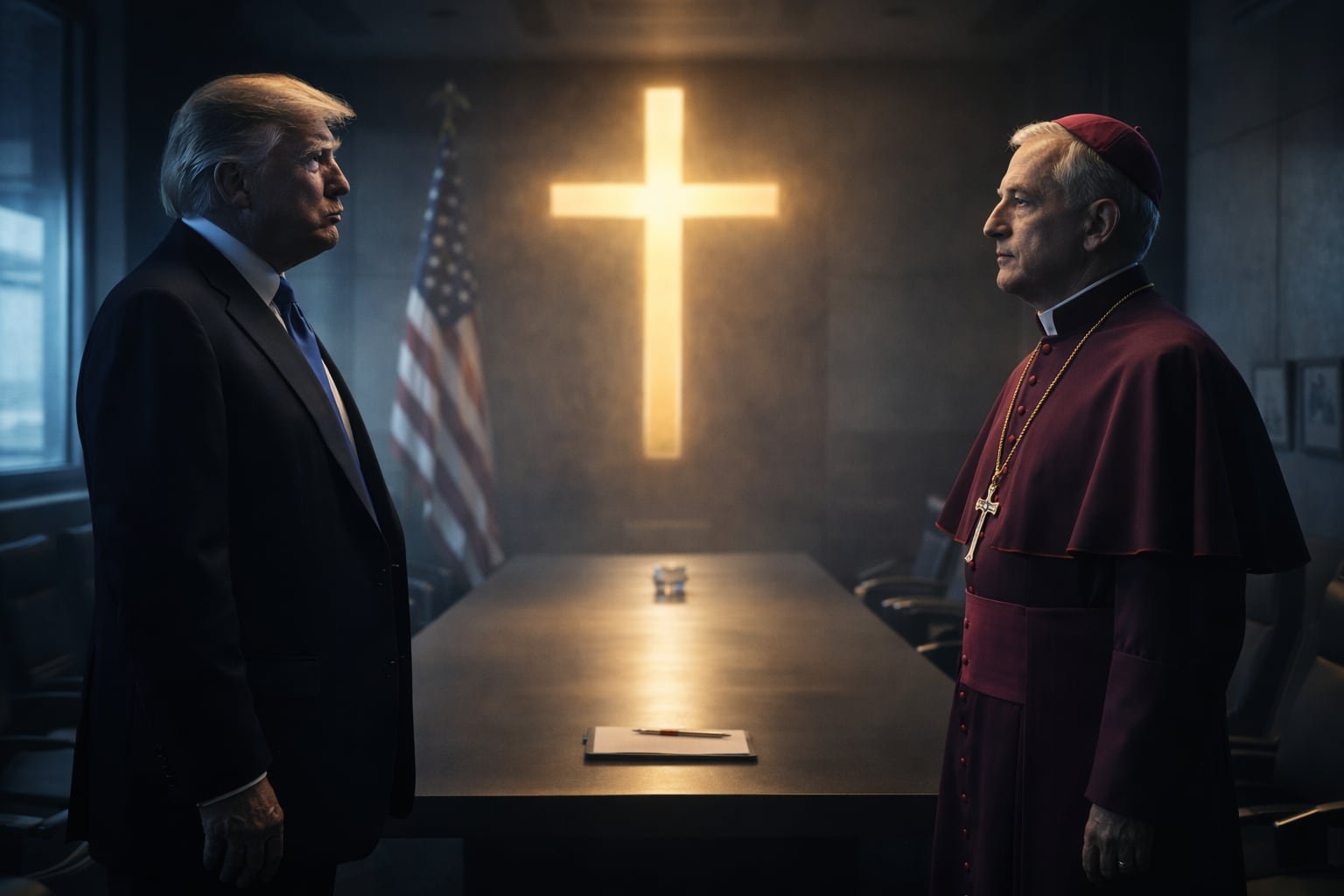
The Facts of a Meeting That Reveals the True Nature of the Conflict
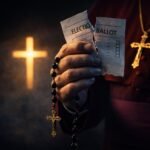
In a closed-door meeting at the Pentagon, Under Secretary of War for Policy Elbridge Colby summoned Cardinal Christophe Pierre, Pope Leo XIV’s ambassador to the United States, and warned him bluntly: “America has the military power to do whatever it wants in the world. The Catholic Church had better take our side.” The explicit reference to the Avignon Papacy – that lamentable 14th-century period when the French crown subjected the Bishop of Rome by force – was no historical slip; it was a veiled threat. This event, reported by The Free Press and analyzed in depth by Christopher Hale in The Letters from Leo (April 8, 2026), is not an isolated incident. It reveals a pattern: the Trump-Vance Administration views the Catholic Church as its most uncomfortable moral critic and responds with the logic of raw power.
The tension did not arise in a vacuum. Pope Leo XIV’s January 2026 “State of the World” address clearly denounced the replacement of diplomacy through dialogue with “a diplomacy based on force.” American bishops have firmly opposed the Administration’s mass deportation regime. After J.D. Vance’s personal invitation for the Holy Father to visit the United States for the 250th anniversary of independence, the Vatican postponed it indefinitely. Instead, Pope Leo XIV will travel to Lampedusa on July 4, 2026 – a symbol of the migrant tragedy. The Pentagon’s response was unmistakable: align or face the consequences.
The Catholic Church, Guardian of the Moral Law That No State Can Silence
Faced with this arrogance, the Church does not remain silent because it cannot. Its mission is not political, yet its moral voice is irrenounceable. The Lord Himself established it: “Render to Caesar the things that are Caesar’s, and to God the things that are God’s” (Mt 22:21). This is not an equal division of powers, but a clear hierarchy: the State holds legitimate authority in temporal matters, but never in moral ones. The Catechism of the Catholic Church states with precision: “The Church, by reason of her mission and her competence, is not to be confused in any way with the political community nor bound to any political system” (CCC 2245). Nevertheless, “the Church has the right and the duty to intervene when the fundamental rights of the person or the salvation of souls require it” (CCC 2246).
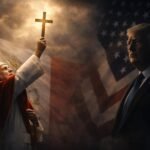
The Trump-Vance Administration cannot tolerate any authority higher than its own. It is not merely anti-Catholic; at its root it is anti-Christian, because it rejects any power that is not its own. Here lies the doctrinal error we must confront with firmness: modern Caesaropapism, in which the State seeks to dictate to the Church not only civil obedience but moral complicity. The Church Fathers already confronted this. St. Ambrose reminded Emperor Theodosius that “the emperor is within the Church, not above it.” Today the Church repeats the same to the contemporary Caesar.
The Avignon Papacy as Warning: History Does Not Repeat, But It Teaches
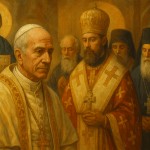
Invoking the Avignon Papacy was no accident. That seventy-year captivity (1309-1377) proved that military force can physically relocate the Pope, but never bend his conscience. The Council of Constance and the restoration of ecclesial unity in Rome confirmed it: the Church emerges strengthened when it resists temporal coercion. Today the threat is not yet physical, but it is spiritual: the attempt to force the Catholic Church to submit to a “Donroe Doctrine” (an updated Monroe Doctrine) that imposes hegemony by force.
Pope Leo XIV has not yielded. Following the incident, he has strengthened his public stance. Cardinal Pierre listened in silence, and the Vatican has held its line. That is the Catholic response: not with arms, but with truth. As the Second Vatican Council taught in Gaudium et Spes (n. 76), “the Church, which by her proper mission and competence is not to be confused with the political community nor bound to any political system, is at the same time the sign and safeguard of the transcendent character of the human person.”
The True Freedom of the Church: Serving God Before Men
This crisis is not merely political. It is a call to Catholics to reaffirm our fidelity. We do not defend a specific pope on a whim; we defend the apostolic principle that “it is necessary to obey God rather than men” (Acts 5:29). The Administration may possess the most formidable military power in history, but it lacks the moral authority to judge the Vicar of Christ. That authority he receives directly from Peter, to whom the Lord entrusted the keys of the Kingdom (Mt 16:19).
In a world that idolizes power, the Church reminds us that Christ alone is Lord. And that truth, however uncomfortable, must be proclaimed without fear. The Pentagon’s attempt at intimidation does not weaken the Church; it purifies her and makes her more credible before a world that seeks, even unknowingly, the only authority that does not corrupt: that of Him who has overcome the world (Jn 16:33).
Sources
- Hale, Christopher (2026). The Pentagon Threatened Pope Leo XIV’s Ambassador With the Avignon Papacy. The Letters from Leo. https://www.thelettersfromleo.com/p/the-pentagon-threatened-pope-leo
- Catechism of the Catholic Church (1992). Libreria Editrice Vaticana.
- Sacred Bible (Official Catholic Version).
- Second Vatican Council, Gaudium et Spes (1965).