

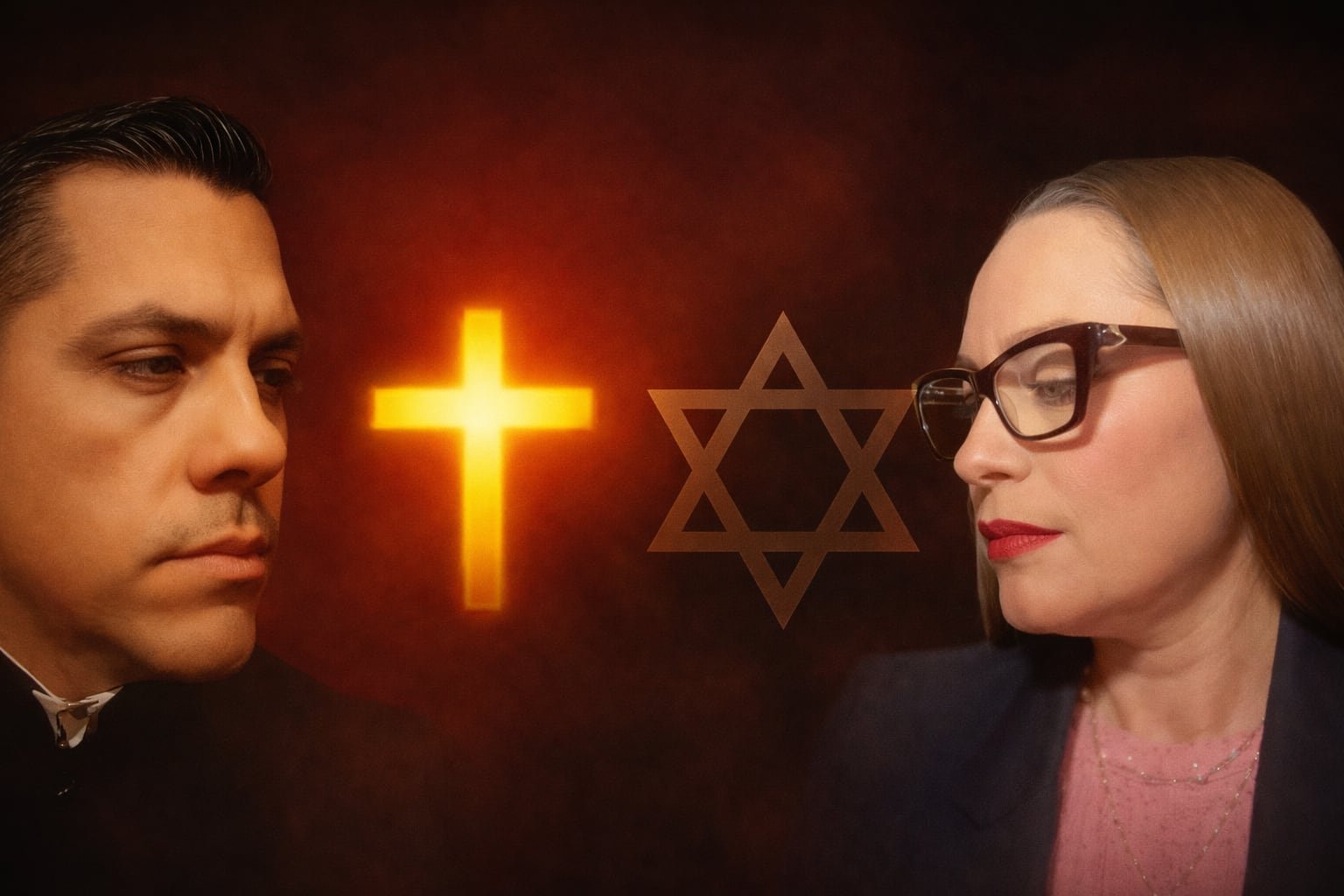
The Catholic faith is not a continuation of Judaism but its fulfillment and surpassing in the Person of Jesus Christ. The term “Judeo-Christian,” when used to describe the deep identity of the Church or Western civilization, creates serious confusion. This is not a mere semantic debate: it touches the heart of the New Covenant announced by the prophets and sealed with the Lord’s blood.
The Word of God Is Inspired, Not Dictated Directly by Christ
Some object that the Bible cannot be the Word of God because Jesus Himself did not write it. This objection forgets the clear teaching of Scripture: “All Scripture is inspired by God and profitable for teaching, for reproof, for correction, and for training in righteousness” (2 Tim 3:16). It does not say “written directly by God,” but inspired. Men, moved by the Holy Spirit, spoke from God (2 Pet 1:21).
Saint Augustine, a converted sinner, and many other imperfect human instruments show that God chooses the weak to confound the strong. The same logic that rejects the Bible for being written by men should also reject apostolic preaching or any evangelization. Yet the Church has always confessed that Sacred Scripture, in its 73 books, is the Word of God transmitted by human authors under divine inspiration.
The Old Testament Prepares; the New Fulfills and Perfects
The Old Testament is not an eternal code that remains intact. It is preparation for the coming of the Messiah. Moses wrote of Christ (Jn 5:46); Abraham rejoiced to see His day (Jn 8:56). The Mosaic law was “our guardian until Christ” (Gal 3:24). Once faith has come, we are no longer under that guardian.
Jesus Himself declares: “Do not think that I have come to abolish the Law or the Prophets; I have not come to abolish them but to fulfill them” (Mt 5:17). The Catechism of the Catholic Church explains clearly: “The New Law fulfills, refines, surpasses, and leads the Old Law to its perfection” (CCC 1967). The promises are elevated to the Beatitudes of the Kingdom; the commandments are internalized in the heart.
Dispensationalism that equates the Old and New Testaments as if both held identical authority today confuses gravely. Genesis 12:3 speaks of blessing through Abraham, but Galatians 3:16 reveals that the promise is fulfilled in Christ and in His offspring, which is the Church.
The Kingdom Was Taken Away and Given to a People Producing Fruits
Jesus warns the leaders of Israel who reject the Son with severity: “Therefore I tell you, the kingdom of God will be taken away from you and given to a people producing its fruits” (Mt 21:43). The Pharisees and scribes understood perfectly that He was speaking of them (Mt 21:45). This is not hatred of the Jewish people, but the logic of the New Covenant: whoever rejects the Messiah loses the exclusive privilege of bearing the Kingdom.
Saint Paul confirms it: “There is neither Jew nor Greek, there is neither slave nor free, there is no male and female, for you are all one in Christ Jesus. And if you are Christ’s, then you are Abraham’s offspring, heirs according to promise” (Gal 3:28-29). The dividing wall has been broken down (Eph 2:14). There is one olive tree; the Gentiles are grafted into it (Rom 11:17-24). There are not two parallel peoples or two separate plans of salvation.
The Council of Jerusalem Marks the Official Break
The first council of the Church, held in Jerusalem around the year 50, resolved that Gentile converts were not bound to circumcision or full observance of the Mosaic law (Acts 15). “It has seemed good to the Holy Spirit and to us to lay on you no greater burden than these requirements” (Acts 15:28). That apostolic decision, guided by the Spirit, definitively separated Christianity from rabbinic Judaism in its essentials. Anyone today who mixes Torah practices with the Gospel as if they were equally compatible contradicts that inspired decision directly.
The term “Judeo-Christian” has a limited historical use for early Christians of Jewish origin who retained some rites. But as a modern identity label for the faith or Western culture, it is a theological oxymoron. Christ did not come to reinforce the old system but to fulfill and surpass it (Heb 8:6-13). The New Covenant makes the first one obsolete, and “what is becoming obsolete and growing old is ready to vanish away” (Heb 8:13).
The Catholic Church, Not Judaism, Gave Us the Bible
The Bible we read did not arise from later rabbinic Judaism. The first Christians used the Septuagint, which included the deuterocanonical books. It was the Catholic Church, in the councils of Rome (382), Hippo (393), and Carthage (397), under the guidance of the Holy Spirit, that defined the canon of the 73 books. The Protestant reformers of the 16th century removed seven books from the Old Testament; the Church added none. Denying this fact is to deny God’s providential action in His Church.
The Sign of the Cross: Trinitarian Profession of Faith, Not Superstition
Claiming that crossing oneself “in the name of the Father and of the Son and of the Holy Spirit” is something negative or demonic reveals ignorance of Tradition. Matthew 28:19 commands baptism in that Name. Already in the second century Tertullian testifies: “In all our travels… we mark our foreheads with the sign of the cross.” The cross is not shame but glory: “We preach Christ crucified, a stumbling block to Jews and folly to Gentiles” (1 Cor 1:23). Making the sign of the cross is to seal oneself with Christ’s victory over the devil and to proclaim the Most Holy Trinity.
Conclusion: There Is Only One Way — the New Covenant in Christ
We are not enemies of the Jewish people. We pray for their conversion, as the Church has always done. But the Catholic faith cannot be diluted into a “Judeo-Christian” synthesis that equates the provisional with the definitive. Our historical root is Hebrew; our fulfillment is Christ. Our identity is not Greco-Roman-Israelite, but Catholic: the apostolic faith that evangelized Greece and Rome, purifying them, and carried the Gospel to the ends of the earth.
Whoever confuses the covenants, whoever mixes the old law with grace as if they were equivalent, or whoever uses the term “Judeo-Christian” as a cultural shield while diluting the exclusive centrality of Christ falls into an intellectual sleight-of-hand that Catholic doctrine firmly rejects. “No one can lay any foundation other than the one already laid, which is Jesus Christ” (1 Cor 3:11).
Let us therefore cross ourselves with conviction. Let us proclaim the Most Holy Trinity. Let us live the New Covenant without lukewarmness. The Church is not a continuation of ancient Israel; she is the Israel of God, the Body of Christ, the Bride of the Lamb. In Him, and only in Him, is salvation.
Sources
- Holy Bible (Catholic version, 73 books).
- Catechism of the Catholic Church (esp. nn. 1967-1968 on the Gospel Law).
- Council of Jerusalem (Acts 15).
- Fathers of the Church: Tertullian (2nd century) on the sign of the cross.
- Councils of Hippo (393) and Carthage (397) on the biblical canon.