
The Day Armageddon Walked Into the Barracks
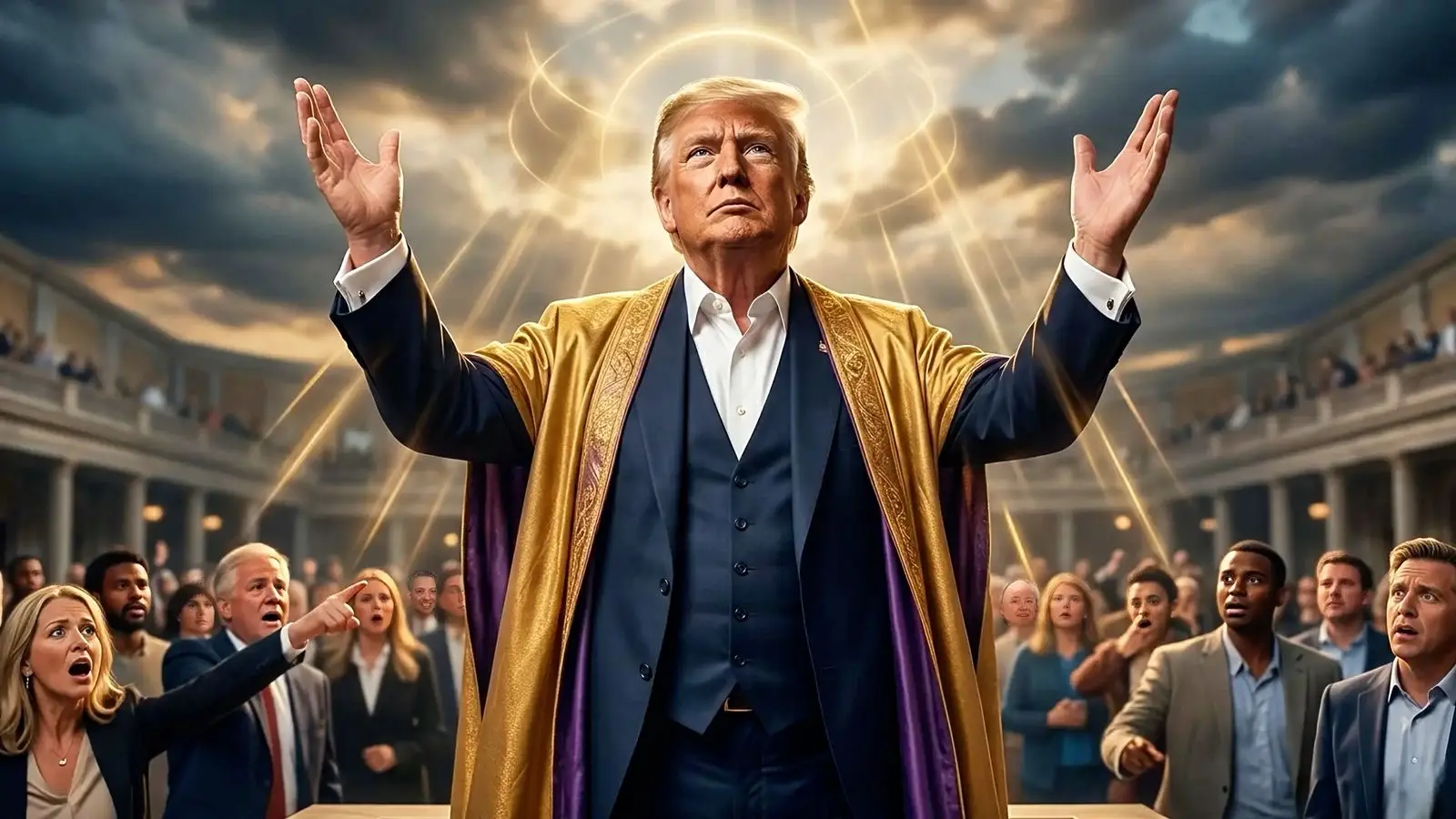
On February 28, 2026, as the United States and Israel launched a coordinated military operation against Iran, something extraordinary was happening inside the barracks of the world’s most powerful military. Soldiers from every branch of the armed forces — the Army, Navy, Air Force, Marine Corps, and Space Force — began reporting that their commanders were telling them something no military protocol justifies: that the war against Iran was part of God’s divine plan, that President Donald Trump had been anointed by Jesus Christ to ignite Armageddon’s signal fire, and that Christ’s return to Earth was imminent.
The Military Religious Freedom Foundation (MRFF), a nonprofit organization founded by military veterans to protect religious freedom within the U.S. armed forces, began receiving an avalanche of complaints that within days would exceed 200 reports from more than 50 military installations worldwide. Its president, Mikey Weinstein, an Air Force veteran and former White House lawyer under three administrations, described what was happening with a clarity that demands serious reflection: mixing religious fanaticism with military power produces, historically, oceans of blood.
One of the non-commissioned officers who filed the complaint wrote on behalf of 15 fellow service members — 11 Christians, one Muslim, one Jewish, and two atheists — to describe how their commander had entered a combat briefing with a wide smile to announce that Donald Trump had been anointed by Jesus to trigger Armageddon. Those words did not come from a street preacher. They came from a superior officer with authority over those men’s lives in combat.
Joe Rogan, on The Joe Rogan Experience, captured the problem with a directness rarely found in public discourse, noting that that kind of person is just as frightening as a suicide bomber. Not because they are inherently violent, but because they share the same mental architecture: the certainty of executing God’s will eliminates every moral brake, every possibility of dialogue, every mechanism of accountability.
But the question that no major media outlet is asking is the most important one: where does this idea come from? Who taught those officers to read the Book of Revelation as an operational map for military action in the Middle East in 2026? The answer has a proper name, and carries nearly two centuries of history behind it. It is called dispensationalism.
The Origins of a Modern Heresy: John Nelson Darby and the Birth of Dispensationalism
Dispensationalism is a theological system — a structured, systematic way of interpreting the Bible and salvation history — that was born in the nineteenth century and today dominates the theology of thousands of evangelical churches worldwide, particularly in North America and Latin America. To understand why what occurred in those military barracks is so grave, it is necessary to understand where this system came from, who built it, and on what foundations it was erected.
Its intellectual father is John Nelson Darby, born in Westminster in 1800, trained as a lawyer, ordained as an Anglican priest in 1825, and later the founder of the movement known as the Plymouth Brethren. Darby developed his theological system between the late 1820s and the 1830s, introducing several ideas that had no precedent in the history of Christian thought. The most influential of these, and the most dangerous in its practical consequences, was the doctrine of the pretribulational secret rapture: the belief that Christ will come secretly before a seven-year period of great tribulation to take true believers to heaven, leaving the rest of the world to face divine judgment.
This idea does not appear in any patristic text. It is absent from every ecumenical council. It was taught by no theologian in the first 1,800 years of Christian history. And the reason for that absence is not that no one had sufficient biblical clarity to see it: the reason is that it is not in the Bible, at least not in the way Darby presented it. There is solid historical evidence that the pretribulational rapture idea originated from a supposed prophetic vision received in 1830 by Margaret Macdonald, a fifteen-year-old Scottish girl belonging to the charismatic movement of pastor Edward Irving. Darby visited Scotland to personally investigate that phenomenon, and on that impulse built the theological scaffolding he then presented to the world as the most faithful and literal interpretation of Scripture possible.
The mass propagation of dispensationalism in the United States occurred primarily through the Scofield Reference Bible, published in 1909 by Cyrus I. Scofield, which incorporated Darby’s theological notes directly between biblical verses. Millions of American Protestants thus began reading the Bible through dispensationalist lenses without knowing it, believing the footnotes were an integral part of the sacred text. The system then spread like wildfire: in 1970 Hal Lindsey published The Late Great Planet Earth, a 28-million-copy bestseller that applied dispensationalism to the geopolitics of the Cold War, and between 1995 and 2007 the Left Behind novel series sold more than 65 million copies, turning these ideas into mainstream popular culture.
The result of that nearly two-century process is what we are witnessing today: military officers who have been theologically formed within dispensationalism, who genuinely believe that any conflict in the Middle East may constitute the fulfillment of a biblical prophecy, and who have risen to positions of sufficient authority to transmit that worldview to their troops at moments of maximum tension.
Dispensationalism Under Scrutiny: Doctrinal Errors and Concrete Consequences
From a Catholic apologetics perspective, dispensationalism accumulates theological errors of varying severity that deserve precise examination — not with the aim of attacking the people who hold these views, but with the clarity that true charity toward truth demands.
The first and most fundamental error is the radical separation between Israel and the Church. Darby taught that they are two completely distinct peoples of God, with separate plans of salvation, with different portions of Scripture applying to each, and with separate eschatological destinies. This position directly contradicts what the Apostle Paul teaches in Galatians when he writes that there is no distinction between Jew and Greek because all are one in Christ Jesus, and what he develops at length in Romans when he presents the Gentiles as branches grafted onto the olive tree that is Israel. The Church is not an accidental parenthesis in God’s plan, as dispensationalism maintains. It is the fulfillment and fullness of the promise made to Abraham, confirmed in Christ and extended to all peoples.
The second error, already mentioned, is the pretribulational secret rapture, whose historical origin is Margaret Macdonald’s 1830 vision rather than apostolic tradition. The question no dispensationalist can answer without intellectual contortion is this: if this doctrine is so central to the Christian faith, how is it possible that no Church Father, no ecumenical council, and no doctor of the Church in 18 centuries ever taught it? Augustine did not know it. John Chrysostom did not preach it. Thomas Aquinas did not systematize it. Because it did not exist until a nineteenth-century Irishman decided he had found something the entire apostolic Tradition had overlooked.
The third error, and the one with the most visible geopolitical consequences today, is the use of biblical prophecies as a foreign policy map. Dispensationalism has constructed a system in which any event in the Middle East can be interpreted as the fulfillment of a prophecy from the Book of Revelation or the prophet Daniel, producing in its believers the sense of privileged access to God’s plan for history. When that mentality gains access to the machinery of power, the effect is precisely what we are documenting: soldiers stripped of their capacity to morally question orders because they have been convinced that obedience is fulfilling God’s will.
Cult expert Steve Hassan has noted that presenting Trump as a divine chosen one and framing the Iran conflict as a holy war fits perfectly the patterns of thought control that characterize authoritarian systems, whose function is to justify violence and suppress dissent. This is not innocent religious rhetoric. It is ideological engineering with real operational consequences.
What the Church Teaches: Scripture, Catechism, and Apostolic Tradition
Against the errors of dispensationalism, the Catholic Church does not simply offer another theological opinion. It offers two thousand years of living Tradition, guaranteed by apostolic succession, corroborated by ecumenical councils, and expressed with precision in the Catechism of the Catholic Church.
On the nature of the Church and its relationship with Israel, the Catechism in paragraphs 781 to 798 teaches that the Church is the new People of God, the organic heir of the promises made to Israel — not its arbitrary replacement but its supernatural fulfillment in Christ. There are not two parallel plans of salvation. There is one, progressive and coherent, which began with creation, was articulated in the covenant with Abraham, was fully revealed in Jesus Christ, and continues alive in his Church.
On eschatology, the Catechism in paragraphs 1038 to 1050 teaches that there will be a second coming of Christ — visible, glorious, and universal — a final judgment, a resurrection of the dead, and the consummation of the Kingdom of God. What the Church does not teach, and has never taught, is a two-phase secret rapture, a seven-year tribulation decodable from newspaper headlines, or the possibility of calculating the date or circumstances of Christ’s return. Jesus himself in Mark 13:32 is absolutely explicit: no one knows that day or hour, not the angels, not the Son, but only the Father.
The Church Fathers bring to this debate an authority that dispensationalism simply cannot invoke in its favor. Ignatius of Antioch, a direct disciple of the Apostle John — the same John who wrote the Apocalypse — insisted in his letters that access to Christ passes necessarily through the hierarchical apostolic Church, not through private interpretations that present themselves as new revelations. Irenaeus of Lyon, who was a disciple of Polycarp, who was himself a disciple of John, warned already in the second century in his Adversus Haereses that separating Scripture from apostolic Tradition and reinterpreting it according to a private system is the defining mark of heresy. That description fits Darby’s system with surgical precision.
Augustine of Hippo, in The City of God, intellectually dismantled the millennialist fantasies of his era by teaching that the millennium of Revelation is not a future historical period of literal thousand years but the age of the Church in which we already live, inaugurated by the Resurrection of Christ. This position, known as amillennialism, is the one the Magisterium of the Church has upheld, and it has behind it the entirety of the apostolic Tradition. John Chrysostom, for his part, established that any eschatology that produces political excitement before interior conversion, that mobilizes troops before it produces saints, is suspicious in its origin and dangerous in its effects.
A Heresy With Real Geopolitical Consequences
What began as a theological dispute among nineteenth-century Anglo-Saxon Protestants has become in 2026 a global security problem with documented consequences. Since Pete Hegseth assumed office as U.S. Secretary of Defense, the Pentagon has seen the introduction of mandatory monthly prayer sessions and the presence of pastors like Doug Wilson — a Christian nationalist theorist who advocates positions such as reversing women’s suffrage and establishing a theocracy in the United States — leading religious services inside the world’s primary military apparatus.
More than two dozen U.S. lawmakers have already demanded a formal investigation of the Department of Defense for the infiltration of apocalyptic rhetoric into the chain of command. One sergeant who filed a complaint with the MRFF summarized the problem with a clarity that should be sufficient: those statements destroy unit morale and cohesion and violate the constitutional oaths that military personnel have taken. A soldier who believes he is fighting the battle of Armageddon does not apply the same proportionality standards as one who answers to international humanitarian law. That difference is not abstract. It is measured in concrete decisions under real fire.
The theological paradox that no one in that ideological ecosystem wishes to examine is this: the evangelical Protestantism that unconditionally supports the State of Israel as prophetic fulfillment does so in the name of a Christian doctrine that that same state rejects. Israel as a state does not recognize Jesus Christ as the Messiah. Israeli rabbis and the modern Sanhedrin do not consider the New Testament a sacred text. The geopolitical alliance between American apocalyptic evangelicalism and the State of Israel is sustained by no real theological convergence, but by a unilateral reading of Scripture in which Israel plays an instrumental role in the Armageddon script without its protagonists being consulted or given any possibility of exit.
That is not the Gospel. It is geopolitics dressed in theological garb, and history records with painful regularity what happens when that disguise goes unquestioned for too long.
📚 Sources
Military Religious Freedom Foundation (MRFF) 2026 MRFF Inundated With Complaints From Troops Over Apocalyptic Rhetoric at Combat Installations https://www.militaryreligiousfreedom.org/2026/03/mrff-inundated-with-complaints/
Democracy Now! 2026 Report: US Commander Told Troops Trump Has Been “Anointed by Jesus” to Wage War on Iranhttps://www.democracynow.org/2026/3/4/headlines/report_us_commander_told_troops_trump_has_been_anointed_by_jesus_to_wage_war_on_iran
El Mostrador 2026 From the “Rapture” to Armageddon: The Growing Influence of Christian Nationalism in the U.S.https://www.elmostrador.cl/unidad-de-investigacion/2026/03/23/desde-el-rapto-al-armagedon-la-creciente-influencia-del-nacionalismo-cristiano-en-ee-uu/
Catechism of the Catholic Church 1997 Paragraphs 781–798 (Church as People of God) and 1038–1050 (Eschatology)https://www.vatican.va/archive/ENG0015/_INDEX.HTM
Christian Leaders Institute History of Dispensationalism: John Nelson Darby and the Origins of Pretribulational Rapture https://christianleaders.org/mod/page/view.php?id=47352
Irenaeus of Lyon ~180 AD Adversus Haereses (Against Heresies) https://www.newadvent.org/fathers/0103.htm
Augustine of Hippo ~426 AD De Civitate Dei (The City of God), Book XX https://www.newadvent.org/fathers/1201.htm