

Dispensationalism, American foreign policy, and the heresy that disguises itself as biblical devotion
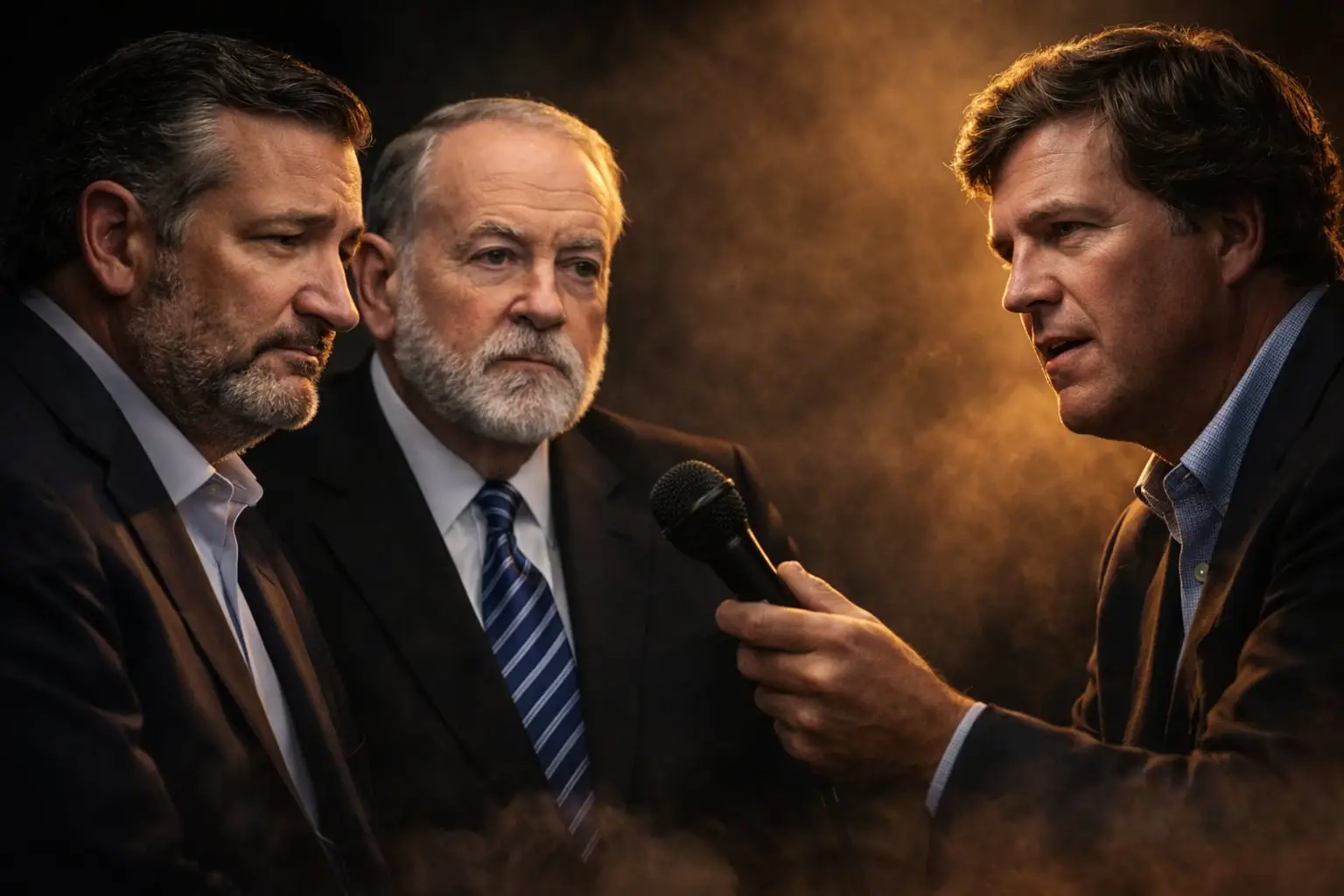
In June 2025, Republican Senator Ted Cruz appeared before Tucker Carlson’s cameras with a statement that encapsulates, in a single sentence, decades of doctrinal confusion: “I grew up in Sunday school and was taught from the Bible that those who bless Israel will be blessed, and those who curse Israel will be cursed. I want to be on the side of blessing.” Carlson interrupted immediately: “Are we as Christians commanded to support the government of Israel?” Cruz responded: “We are commanded to support Israel.” Then Carlson asked the question that left the senator without an answer: “Where does the Bible say that?” Cruz did not know. It was Carlson who had to remind him that the text was in Genesis 12. The man who had made that verse the foundation of his foreign policy could not even cite the chapter.
This is not an anecdotal moment. It is the visible symptom of a doctrinal crisis that has been incubating for more than one hundred and fifty years in the Anglo-Saxon Protestant world and that today has measurable geopolitical consequences, real victims, and a media reach of tens of millions of people. In February 2026, Mike Huckabee — United States Ambassador to Israel, ordained Baptist minister, and self-confessed Christian Zionist — went even further: when Carlson cited Genesis 15 and asked whether Israel had a biblical right to lands that today include Syria, Lebanon, Iraq, Jordan, and part of Egypt, Huckabee responded: “I wouldn’t have a problem if they took all of it.” A joint statement by more than a dozen Arab and Muslim countries followed immediately. Saudi Arabia spoke of “extremist rhetoric.” The Arab League said it lacked “any solid basis.” And the United States Embassy attempted to contain the damage by claiming the comments had been taken out of context, while Huckabee, on Trinity Broadcasting Network, cited Genesis 12:3 as the summary of his diplomatic mission.
The Origin of the Error: John Nelson Darby and Dispensationalism
To understand what we are witnessing, we must go to the origin. Christian Zionism did not begin with Ted Cruz or Mike Huckabee. It began in the nineteenth century with a figure named John Nelson Darby, an Irishman who left the Church of England in the 1820s and began developing a doctrine known today as dispensationalism. This theology divides the history of salvation into “dispensations” or separate periods, each with different rules, and claims that the promises made to Israel in the Old Testament have not been fulfilled in Christ but remain pending and will be fulfilled literally at the end of time through a restored Jewish state in Palestine. From Darby, this doctrine passed to Cyrus Scofield, whose annotated Bible — published in 1909 — popularized dispensationalism in millions of Anglo-Saxon Protestant homes. Today, that theology shapes American foreign policy with an influence that no other modern theological school can claim.
Senator Cruz, according to data from OpenSecrets.org, had received over one million eight hundred thousand dollars in donations from pro-Israel groups by 2024. Theology has a price. And that price has an electoral receipt.
What Genesis 12 Says and What It Does Not Say
Let us go to the text. Genesis 12:1-3 reads: “The Lord said to Abram: Go from your country, your kindred and your father’s house to the land that I will show you. I will make of you a great nation, and I will bless you, and make your name great, so that you will be a blessing. I will bless those who bless you, and the one who curses you I will curse; and in you all the families of the earth shall be blessed.” There are three fundamental realities that dispensationalism systematically ignores.
First: the subject of the blessings and curses is Abram — not Israel, not the Jews, not the State of Israel, not any twentieth-century government. The promise is personal and directed to a specific individual who has not yet even arrived at the promised land. Second: the verse says “in you all the families of the earth shall be blessed” — not one nation. All of them. The promise is not one of ethnic exclusion but of universal inclusion through the offspring of Abraham. Third, and decisively: the verse never mentions the word “Israel.” Israel did not exist. Jacob, who would receive that name decades later, had not yet been born. The modern State of Israel was founded on May 14, 1948, by political decision of David Ben-Gurion — not by any direct biblical prophecy.
What Cruz and Huckabee do is a logical and historical leap of extraordinary proportions: they take a promise made to a nomad of the second millennium before Christ, strip it entirely of its context, remove its christological fulfillment, and apply it to a secular twentieth-century state that largely rejects Jesus Christ as Messiah.
Paul’s Answer: Christ Is the Offspring
The Apostle Paul resolves this matter with a clarity that leaves no room for ambiguity. In Galatians 3:7-9 he writes: “Understand, then, that those who have faith are children of Abraham. Scripture foresaw that God would justify the Gentiles by faith, and announced the gospel in advance to Abraham: All nations will be blessed through you. So those who rely on faith are blessed along with Abraham, the man of faith.” The heirs of the Abrahamic promise are those who share the faith of Abraham, not those who share his blood. The inheritance is spiritual, not ethnic. It is by faith, not by DNA.
“The promises were spoken to Abraham and to his seed. Scripture does not say ‘and to seeds,’ meaning many people, but ‘and to your seed,’ meaning one person, who is Christ.”GALATIANS 3:16
There it is, with surgical precision. The offspring of Abraham, the ultimate heir of the promises of Genesis, is Christ. Not Netanyahu. Not the State of Israel. Christ. Paul returns to this argument in Romans 9:6-8: “It is not as though God’s word had failed. For not all who are descended from Israel are Israel. Nor because they are his descendants are they all Abraham’s children… it is not the children of the flesh who are God’s children, but it is the children of the promise who are regarded as Abraham’s offspring.” The apostle is absolutely explicit: not all biological descendants of Abraham are heirs of the promise.
The Magisterium of the Church: Doctrine Without Ambiguity
The Catechism of the Catholic Church acknowledges the special relationship of the Jewish people with God and the irrevocable character of the covenant, but nowhere does it assert that Christians have a political obligation to support the State of Israel.
CCC §839–840
The Second Vatican Council, in Nostra Aetate, articulated the Church’s relationship with Judaism with genuine theological depth and nuance, but nowhere equates support for the modern State of Israel with an obligation derived from Genesis 12. In January 2026, the Patriarchs and Heads of the Churches in Jerusalem — including Eastern Catholic Churches and other historic communities of the Holy Land — issued a joint statement describing Christian Zionism as “a harmful ideology that misleads the faithful, sows confusion and damages the unity of Christian communities in the Holy Land.” These are pastors who have cared for Christians in that land for centuries — far more qualified to speak of it than any senator or ambassador operating from the comfort of Washington.
The Church Fathers: What the First Centuries Taught
The dispensationalist error is a nineteenth-century invention. The early Church Fathers knew better — because they lived closer to the apostles — and taught precisely the opposite. Saint Justin Martyr, in his “Dialogue with Trypho” written around 155 AD, argued directly with a Jewish interlocutor that the promise made to Abraham had been fulfilled in Christ and in all who share the faith of Abraham, regardless of ethnic origin. For Justin, the Israel of God was not a racial category but a category of faith.
Saint John Chrysostom, in his Homilies on Galatians and Romans, insisted that the promise to Abraham was a promise of universality — “in you all nations shall be blessed” — and that its fulfillment was Christ, through whom all nations of the world have access to the Father. Saint Irenaeus of Lyon, in “Against Heresies,” established that the Church is the new people of God, heir to the promises of the Old Testament by virtue of its union with Christ. Saint Augustine of Hippo, in “The City of God,” developed a theology of history that places the Church — not any territorial state — as the people of the promise in the age of the New Covenant. What Cruz, Huckabee, and dispensationalism do is what the Fathers would have called a Judaizing reading of Scripture: taking the Old Testament without passing it through the filter of fulfillment in Christ.
The Political Function of a Convenient Theology
There is a question most people do not ask: why is this theology so politically useful? Because if you can convince millions of Christian voters that supporting a specific state is a religious obligation, you have created an electoral base that cannot be questioned without the questioning itself becoming automatically sinful. You have built an ideological shield around a foreign policy. Anyone who doubts is “the one who curses.” Anyone who questions the funding or the consequences is choosing the curse. It is a mechanism of social control with a Bible verse attached.
It is worth noting that Tucker Carlson himself — not a Catholic, not a Church apologist, but an Episcopalian journalist with his own motivations — was able to challenge that argument more effectively than many pastors and religious leaders. That speaks to a level of indoctrination so deep that people feel more comfortable questioning geopolitics than questioning the theology that sustains it. And the claim that Hugo Chávez died of cancer because he “cursed Israel” illustrates how far this distortion has penetrated popular thinking: there is no biblical, theological, or any other kind of mechanism that establishes that criticizing the policies of the State of Israel causes cancer. None. It is superstition with a Bible verse attached. The God of Scripture is not the security system of a state founded in 1948.
Conclusion: The Offspring of Abraham Is Christ
Dispensationalism took Genesis 12, tore it from its christological context, separated it from its fulfillment in Christ, and deliberately ignored Paul, Justin, Irenaeus, Augustine, and Chrysostom — converting it into foreign policy with campaign checks attached. The Catholic Church, founded on Peter, custodian of the apostolic Tradition and the uninterrupted Magisterium of twenty centuries, has no doubt on this point: the promises of Genesis 12 are fulfilled in Christ.
The true Israel is the Church, the new people of God composed of all nations who share the faith of Abraham — faith in the God who revealed himself fully in Jesus Christ. No modern state, no government, no geographic border holds the monopoly on the blessing of God. The blessing of God is not a foreign policy. It is the Incarnation. It is the Cross. It is the Resurrection. The next time someone tells you that you have a Christian obligation to support a specific government because “God curses those who curse it,” you already have the answer. Not with insults. Not with emotional reaction. With Paul, with the Fathers, and with twenty centuries of Tradition that say, with one voice, that the offspring of Abraham who inherits the promises is one: and that offspring is Christ.
Sources and Doctrinal References
- Ted Cruz – Tucker Carlson Interview, June 18, 2025 (The Tucker Carlson Encounter, X/YouTube)
- Christian Post: “Ted Cruz cites Genesis 12:3 as personal motivation for supporting Israel” (Jun 19, 2025)
- NBC News: “Outcry after Ambassador Mike Huckabee suggests Israel has God-given right to Middle East land” (Feb 23, 2026)
- Middle East Eye: “Mike Huckabee’s distorted theology does not speak for Christians worldwide” (2026)
- Catholic.com: “Are Christians Commanded to Support Israel?” (Jun 2025)
- OpenSecrets.org: Pro-Israel donations to Ted Cruz (over $1.8M through 2024)
- Catholic Bible: Genesis 12:1-3; Galatians 3:7-16; Romans 9:6-8
- Catechism of the Catholic Church: §839, §840
- Second Vatican Council: Nostra Aetate
- St. Justin Martyr: Dialogue with Trypho (c. 155 AD) — New Advent
- St. Irenaeus of Lyon: Against Heresies, Book IV — New Advent
- St. Augustine of Hippo: The City of God, Book XVI — New Advent
- St. John Chrysostom: Homilies on Galatians — New Advent
- Joint Statement of the Patriarchs and Heads of Churches in Jerusalem against Christian Zionism, January 2026
- The Forward: “How Tucker Carlson and Ted Cruz’s biblical bickering explains the MAGA divide on Israel” (Jun 24, 2025)
- Arab Center DC: “Israel, Christian Zionism, and Mike Huckabee” (2026)