

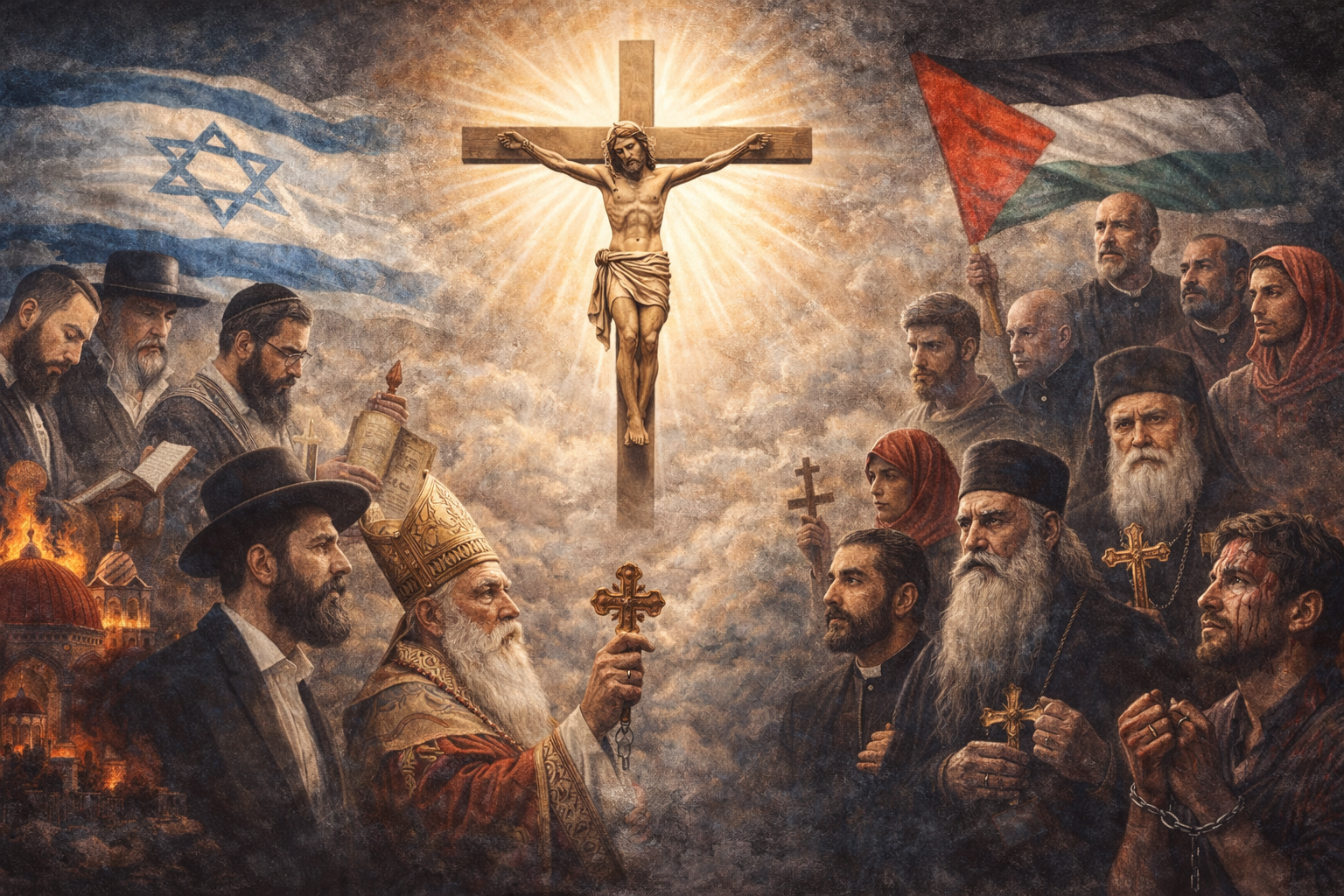
A First Biblical and Christian Refutation of Dispensationalism
In recent months, it has become increasingly common on social media to see Genesis 12:3 cited—often implicitly—as if it were a permanent geopolitical clause:
“I will bless those who bless you…”

I have seen posts, including one by Gerardo Wilhelm, implying that God’s blessing automatically rests upon those who politically “bless” the modern State of Israel, and that those who do not align with it place themselves under divine curse.
I want to state this clearly and without ambiguity:
this reading is neither biblical, nor Christian, nor Catholic.
It is a dispensationalist reading—modern, Protestant in origin, and foreign both to biblical Judaism and to apostolic Christianity.
1. The Fundamental Error: Confusing Election with Exclusivity
The promise made to Abraham in Genesis 12:3 does not end with Israel. The text explicitly says:
“In you all the families of the earth shall be blessed.”
Israel is not the goal of the promise; it is the instrument.
The election of Israel was never an absolute ethnic privilege nor a guarantee of perpetual supremacy. It was a historical vocation:
to bring forth the Messiah through whom God would bless the entire world.
Reducing this promise to an automatic political endorsement of a modern nation-state is not only poor exegesis—it is a betrayal of the biblical text itself.
2. Isaiah Does Not Contradict This (Using Him Otherwise Is a Fallacy)
In these debates, Isaiah 43:1 is often cited:

“Fear not, for I have redeemed you; I have called you by name, you are mine.”
This passage affirms God’s faithful love for Israel—something Christianity has never denied. But it does not affirm salvific exclusivity, nor does it establish perpetual political supremacy.
In fact, the same prophet proclaims:
“I will make you a light to the nations, that my salvation may reach to the ends of the earth.” (Isaiah 49:6)
Isaiah confirms precisely the opposite of exclusivism:
Israel is chosen for the sake of others.
To use Isaiah to justify exclusivity is to read him selectively and ideologically.
3. The Christian Interpretation Is Clear: St. Paul Settles the Question
This is where dispensationalism ultimately collapses.
St. Paul definitively interprets the promise to Abraham:
“The promises were made to Abraham and to his offspring… and that offspring is Christ.”
(Galatians 3:16)
He then adds:
“There is neither Jew nor Greek… for you are all one in Christ Jesus.”
(Galatians 3:28)
For apostolic Christianity, the structure is unmistakable:
- The promise does not terminate in ethnic Israel
- It is fulfilled in Christ
- And it is opened to Jews and Gentiles alike
This is not liberal theology.
It is apostolic theology.
4. Dispensationalism: A Modern Doctrine, Not a Biblical One
This must be stated plainly.
Dispensationalism:
- Emerges in the 19th century
- Is unknown to the Church Fathers
- Was not taught by the apostles
- Has no place in historic Christian tradition
It turns the Bible into:
- A manual of geopolitics
- A theology of power blocs
- A literalist reading with Christ displaced from the center
It is a hermeneutic without the Cross, without the Church, and without the sacraments.
5. The Catholic Position: Clear and Non-Negotiable
The Church teaches, simultaneously, that:
- God truly chose Israel
- God’s promises are not revoked
- Christ is the definitive fulfillment
- The Church is the People of God in Christ
- There is no eternal political or ethnic privilege apart from the Messiah
As the Catechism teaches, the Church does not annul Israel’s vocation—she brings it to fulfillment in Christ.
This is not crude replacement theology.
But it is also not dispensationalism.
6. God’s Blessing Does Not Exclude Eastern Christians
One of the gravest consequences of modern dispensationalism is that it erases millions of real, living, suffering Christians from salvation history because they do not fit a political framework.
If Genesis 12:3 were read as an exclusive and automatic blessing for Jews of the current State of Israel, one would have to conclude—absurdly—that:
- Palestinian Christians
- Egyptian Copts
- Syriac Christians
- Armenians
- Eastern Orthodox believers
- Catholics of the Holy Land
are not recipients of God’s blessing.
That conclusion is theologically untenable.
Palestine: Christians Before Any Modern State
Palestinian Christians are not a recent invention.
They are descendants of the earliest Christian communities of the first century.
- They worshiped Christ before Islam
- They lived the faith before modern geopolitical conflicts
- They preserve apostolic liturgies, languages, and traditions
To deny that they are blessed by God while absolutizing ethnic or state criteria is a betrayal of the Gospel.
Election Is No Longer Ethnic: It Is Christological
St. Paul is unambiguous:
“One is not a Jew outwardly… but one inwardly.”
(Romans 2:28–29)
And he concludes:
“If you belong to Christ, then you are Abraham’s offspring, heirs according to the promise.”
(Galatians 3:29)
This includes:
- Jews who believe in Christ
- Baptized Gentiles
- Christians of East and West
- Persecuted and forgotten Churches
Election now passes through Christ—not through bloodline, territory, or statehood.
The Church does not replace Israel; she fulfills it.
The Catholic position is neither vulgar substitutionism nor dispensationalism.
Israel was truly chosen.
Its vocation was not revoked.
But its fullness is realized in Christ and extended to all nations.
Conclusion: What Genesis 12:3 Really Teaches
Genesis 12:3 does not promise automatic blessing to modern states.
It does not justify political alliances.
It does not legitimize nationalist theologies.
It teaches something far more radical and demanding:
God blesses the whole world through Christ.
Election is mission, not supremacy.
The promise culminates in the Cross, not on a map.
Reducing Genesis 12:3 to a modern political slogan is not merely an exegetical error.
It is a spiritual injustice against millions of Christians who:
- Confess Christ
- Have endured centuries of martyrdom
- Belong to the same Body
The blessing promised to Abraham does not belong to a passport.
It belongs to Christ.
And where Christ is,
there is the chosen people.
Sources
St. Paul, Epistles to the Galatians and Romans
The Holy Bible (Catholic canon, 73 books)
Catechism of the Catholic Church, nn. 59–60, 781–786
St. Irenaeus of Lyons, Against Heresies
St. Augustine, The City of God