
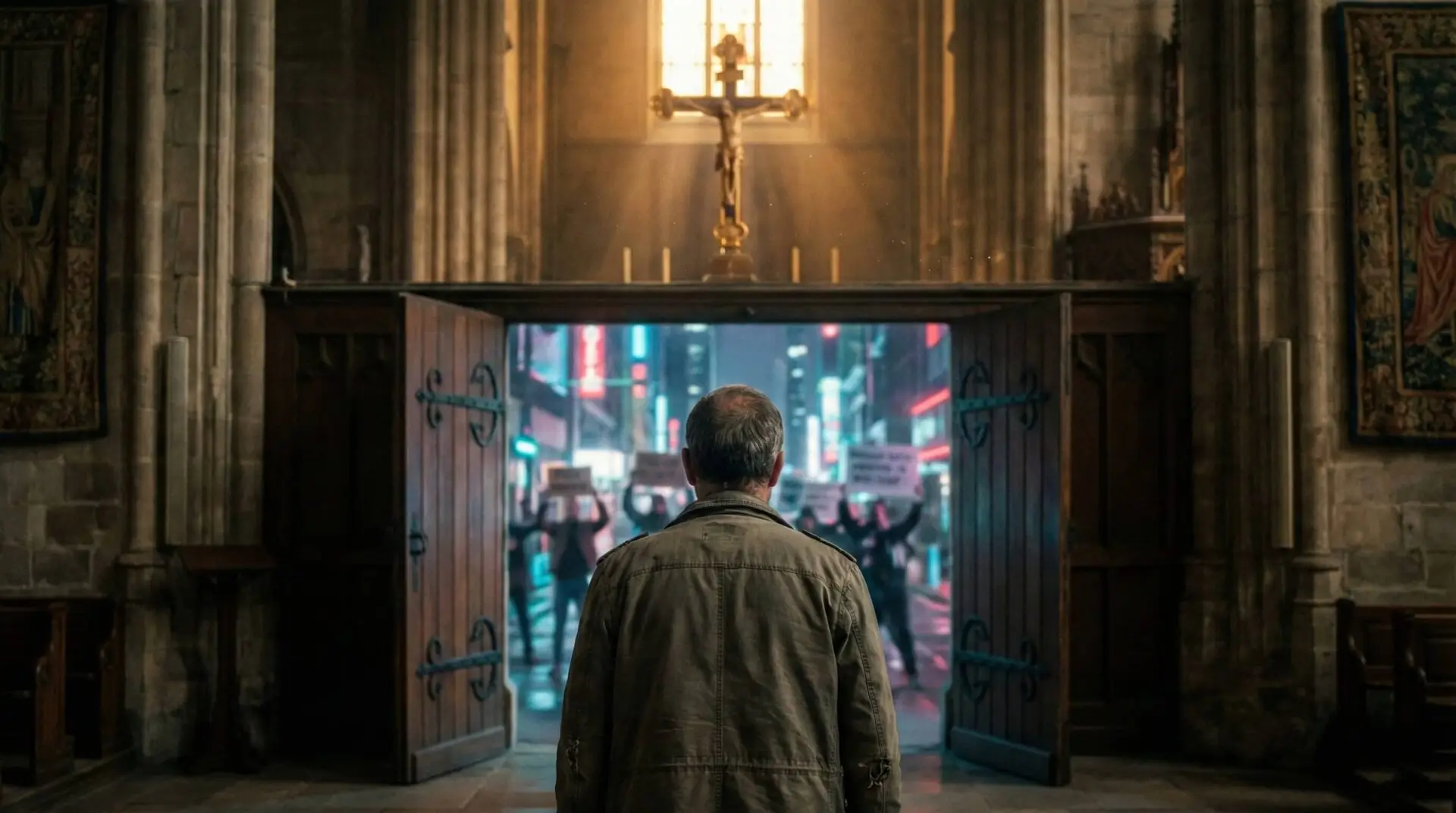
In recent years, I have repeatedly encountered the same question: What does it really mean to be “woke”? Is it simply heightened awareness of injustice, or are we facing a cultural worldview that competes directly with Christianity?
This is not an emotional reaction piece. It is a doctrinal and philosophical analysis written from within the Catholic intellectual tradition. My aim is discernment, not caricature.
The Origin of the Term “Woke”: From Awareness to Ideology
The term woke originally emerged in 20th-century African American vernacular, meaning to remain “awake” or aware of racial injustice. In its earliest usage, it referred to moral vigilance.
However, in the 21st century, the concept expanded beyond racial awareness and became embedded in broader frameworks derived from postmodern philosophy and critical theory. Scholars such as Helen Pluckrose and James Lindsay document this intellectual shift in Cynical Theories (2020), showing how contemporary social justice discourse absorbed elements from postmodernism.
A crucial turning point lies in the influence of thinkers like Michel Foucault, who argued that knowledge and power are inseparable. If truth is understood primarily as a product of power structures, then reality itself becomes something to deconstruct rather than to discover.
At this stage, we are no longer discussing social awareness. We are confronting a competing epistemology.
Social Justice: Catholic Teaching vs. Woke Ideology
It is essential to state clearly: the Catholic Church has always defended social justice.
The Catechism of the Catholic Church (n. 1928) teaches:
“Society ensures social justice when it provides the conditions that allow associations and individuals to obtain what is their due according to their nature and vocation.”
The Church’s understanding of social justice rests upon:
- The natural law.
- The inherent dignity of every human person created in the image of God (Genesis 1:27).
- The universality of sin (Romans 3:23).
- The universality of redemption in Christ.
By contrast, in many contemporary “woke” frameworks:
- Moral categories are structured around oppressed and oppressor identities.
- Identity groups often determine moral authority.
- Justice is reinterpreted through structural power analysis.
- Truth becomes socially constructed rather than metaphysically grounded.
St. John Paul II warned in Centesimus Annus (1991) that ideologies which reduce the human person to economic or structural categories distort authentic human dignity.
The tension here is not political—it is anthropological.
Is Woke Culture a Secular Religion?
I do not use this phrase as an insult, but as sociological analysis.
Observers such as John McWhorter have described contemporary antiracist orthodoxy as functioning like a religion. Consider some structural parallels:
- Foundational dogmas that may not be questioned.
- A doctrine of inherited privilege.
- Public rituals of repentance.
- Social excommunication through cancellation.
- Moral absolutism without transcendence.
The Catechism (n. 675) warns that before Christ’s return, humanity will face forms of “religious deception” that offer apparent solutions to human problems at the price of abandoning the truth.
When identity replaces nature and narrative replaces metaphysical truth, we are no longer debating policy—we are confronting a rival moral vision.
Christ declared:
“You will know the truth, and the truth will set you free” (John 8:32).
If truth is reduced to social construction, freedom becomes submission to prevailing ideological power.
Corporate Signaling and the Culture of Cancellation
Another dimension of woke culture is corporate alignment with identity-based activism. Many companies adopt symbolic positions on social issues, sometimes less from conviction than from reputational calculation. Philosopher Alasdair MacIntyre argued in After Virtue (1981) that modern societies have fallen into emotivism—where moral claims are reduced to expressions of preference rather than objective truths. When ethics becomes branding, morality becomes performance. The Catholic moral tradition, by contrast, insists that moral truth does not depend on consensus but on conformity to divine and natural law.
Christian Anthropology vs. Identity Anthropology
The deepest conflict lies in competing visions of the human person.
Christian Anthropology:
- The human being possesses a stable nature.
- Biological sex is not a social construct.
- Identity flows from nature, not vice versa.
- Dignity is intrinsic, not granted by cultural recognition.
Identity-Based Anthropology:
- The self is self-constructed.
- Identity precedes biology.
- Moral authority is tied to group experience.
- Nature is secondary to self-definition.
St. Paul exhorts:
“Do not be conformed to this world, but be transformed by the renewal of your mind” (Romans 12:2).
The Church rejects injustice, racism, and cruelty. But it cannot accept the redefinition of human nature.
How Should Catholics Respond?
- With charity, not hostility.
- With intellectual formation.
- With anthropological clarity.
- With fidelity to revealed truth.
We must avoid reactionary anger while also resisting ideological capitulation.
St. Paul advises:
“Test everything; hold fast to what is good” (1 Thessalonians 5:21).
Discernment—not fear—is the Catholic path.
Conclusion: More Than a Trend, a Worldview
To be “woke” today often means more than being aware of injustice. In its developed ideological form, it involves adopting a framework that redefines:
- Truth
- Moral authority
- Human identity
- The nature of justice
As a Catholic, I cannot accept a worldview that replaces sin with structural privilege, redemption with activism, and nature with self-construction.
Ideologies rise and fall. The truth revealed in Christ endures.
Academic and Doctrinal Sources
- Catechism of the Catholic Church, nn. 1928, 675.
- St. John Paul II, Centesimus Annus (1991).
- Sacred Scripture (Catholic Canon): Genesis 1:27; John 8:32; Romans 3:23; Romans 12:2; 1 Thessalonians 5:21.
- Pluckrose, Helen & Lindsay, James. Cynical Theories. Pitchstone Publishing, 2020.
- MacIntyre, Alasdair. After Virtue. University of Notre Dame Press, 1981.
- McWhorter, John. Woke Racism. Portfolio, 2021.
- Foucault, Michel. Power/Knowledge. Pantheon Books, 1980.