

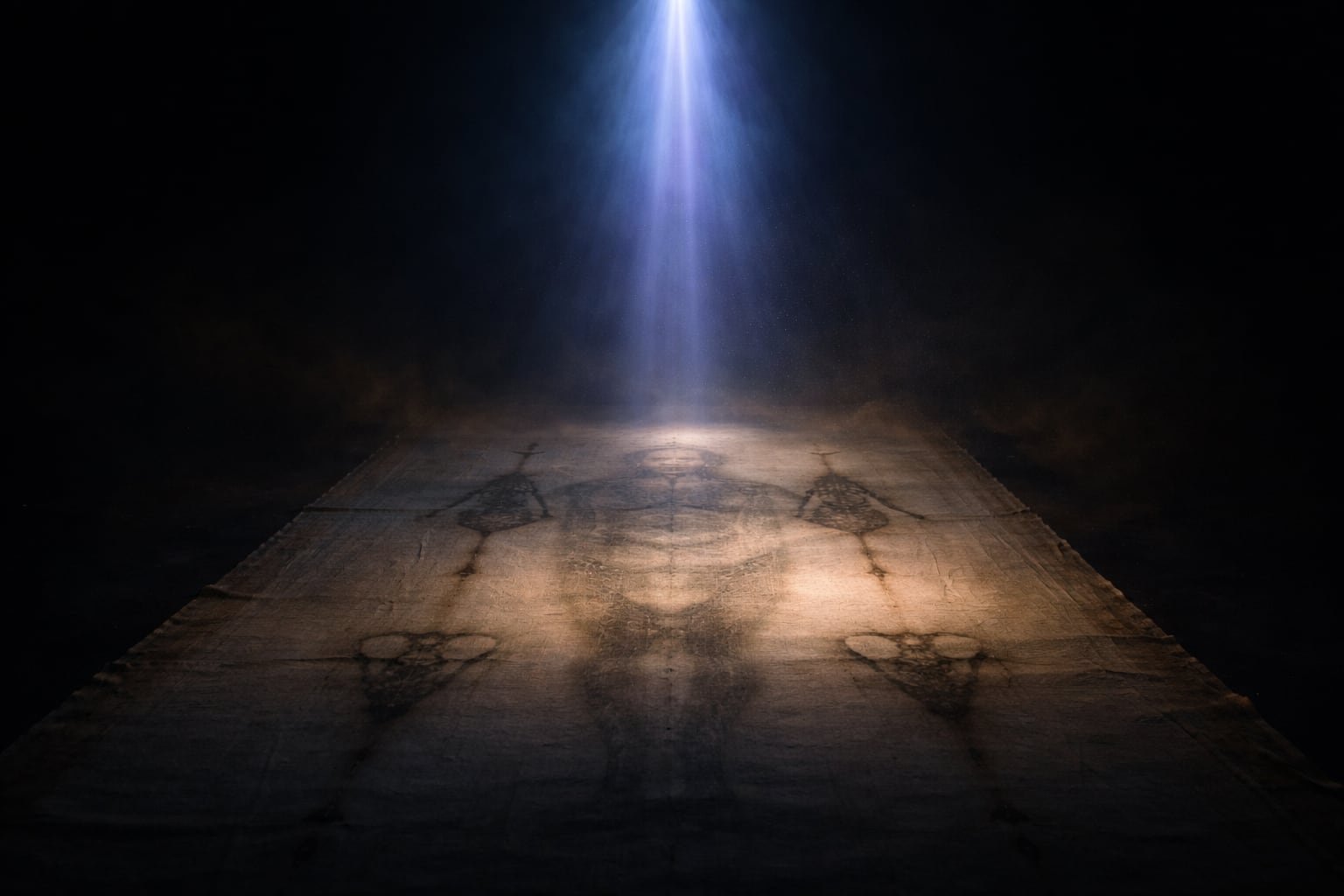
The Shroud of Turin is not merely a medieval relic or a pious devotional object. It is a silent yet irrefutable witness to an event that transcends the laws of known physics: the Resurrection of Our Lord Jesus Christ. A recently viral reminder shared by CatholicVote has once again highlighted the results of Italian physicist Paolo Di Lazzaro, lead researcher at the ENEA Frascati Centre. After five years of rigorous attempts with state-of-the-art ultraviolet laser technology, his team failed to reproduce the full body image visible on the Shroud. They achieved only small areas of discoloration; recreating the entire figure proved impossible with modern technology.
This failure is not a scientific dead end. It is a gateway to theological truth. The image on the Shroud was formed by a process requiring extraordinary energy: according to Di Lazzaro’s estimates conveyed by biblical scholar Jeremiah Johnston, it would demand 34,000 billion watts of energy delivered in one-fortieth of a billionth of a second to chemically alter fine linen without scorching it. Had the pulse lasted even a fraction longer, the fabric would have burned. “We do not have that power on Earth,” the scientist himself acknowledged.
The Physical Impossibility of the Image
The Shroud of Turin displays unique characteristics that no human method has fully replicated. The image is superficial, affecting only the outermost linen fibrils without penetrating deeper layers. It is a photographic negative that reveals precise anatomical details — flagellation wounds, crown of thorns, pierced side — and, when digitally processed, yields a three-dimensional relief unattainable by medieval painting techniques. There are no pigments, dyes, or brush marks. It is a chemical discoloration of the linen itself.
Di Lazzaro’s ENEA team experiments (2005–2010) using excimer lasers in the ultraviolet and vacuum-ultraviolet spectrum demonstrated that only high-energy radiation in the deep UV range can produce a similar coloration in tone, superficiality, and lack of fluorescence. Yet scaling this process to the dimensions of a human body requires power and temporal brevity that exceed any known light source today. This is not an “artistic effect.” It is a radiative event of colossal intensity, confined to an infinitesimal instant.
As the Catechism of the Catholic Church teaches, Christ’s Resurrection is “the crowning truth of our faith” (CCC 638). It is not a symbol or metaphor, but a historical and physical fact: Jesus’ dead body, buried according to Jewish custom, emerged from the tomb alive, glorious, and incorruptible. St. Paul declares it plainly: “If Christ has not been raised, then our preaching is in vain and your faith is in vain” (1 Cor 15:14). If authentic — and scientific evidence strongly points in that direction — the Shroud would be the physical “receipt” of the moment when matter and divine energy met in an act of total re-creation.
Confronting Modern Skepticism
Those who dismiss the Shroud as a “medieval forgery” ignore the accumulated data from the 1978 STURP investigation to more recent studies. The 1988 carbon-14 dating, so often cited by skeptics, has been seriously challenged due to contamination and flawed sampling. Meanwhile, palynology, forensic analysis of the wounds, and the optical properties of the image remain without natural explanation.
Di Lazzaro is not a Catholic apologist; he is a physicist with decades of experience in radiation-material interactions. His conclusion does not seek to prove faith, but it makes clear that any naturalistic hypothesis collides with insurmountable limits. The required energy does not derive from any known phenomenon: neither lightning, electrical discharges, nor slow chemical processes. Only a supernatural “burst of light,” consistent with the theology of the Resurrection as the glorious transformation of the body (cf. Phil 3:21), fits the observed parameters.
The Church Fathers already contemplated the Resurrection as a mystery of divine power. St. John Chrysostom affirmed that Christ rose “not like the dead who rise to die again, but to live forever.” The Shroud appears to capture the very instant when the Incarnate Word, by the power of the Spirit, glorified His humanity, leaving a trace that science can only approach, never reproduce.
Implications for Faith and Contemporary Culture
In an age of relativism and materialism, where everything is expected to be explained by immanent laws, the Shroud of Turin confronts modern man: Are you willing to accept that science has limits and that divine Revelation provides the ultimate answer? It is not a matter of “proving” faith with microscopes, but of recognizing that right reason opens the path to faith. As the First Vatican Council teaches, human reason can know God with certainty from created works, yet faith elevates that certainty to the supernatural certainty of the Gospel.
The Shroud’s image is not an idol. It is a sign pointing to the Paschal Mystery. It invites us to contemplate the suffering and glorious face of Christ, to unite ourselves to His Passion, and to await with firm hope the resurrection of the flesh that we profess in the Creed.
May this scientific evidence, far from generating sterile controversy, impel believers to proclaim with greater boldness that “The Lord has truly risen” (Lk 24:34). And may skeptics, at the very least, recognize the intellectual honesty of admitting: here science falls silent and faith speaks with authority.
Sources
- Di Lazzaro, Paolo et al. “Shroud-like coloration of linen by ultraviolet radiation”. ENEA, 2010-2015.
- Available in technical reports from the Frascati Research Centre.
- Johnston, Jeremiah. Statements in interview with Shawn Ryan Show (referenced in recent 2026 reports).
- Catechism of the Catholic Church, nn. 638-658. Libreria Editrice Vaticana.
- Holy Scripture: 1 Corinthians 15; Philippians 3:21; Luke 24.
- Daily Mail, “Scientists say light experiment proves Jesus’ resurrection”, April 2026.
- https://www.dailymail.co.uk/sciencetech/article-15712935/jesus-resurrection-shroud-turin-experiment.html
- Sci.News and ENEA publications on excimer laser irradiation (2011).