
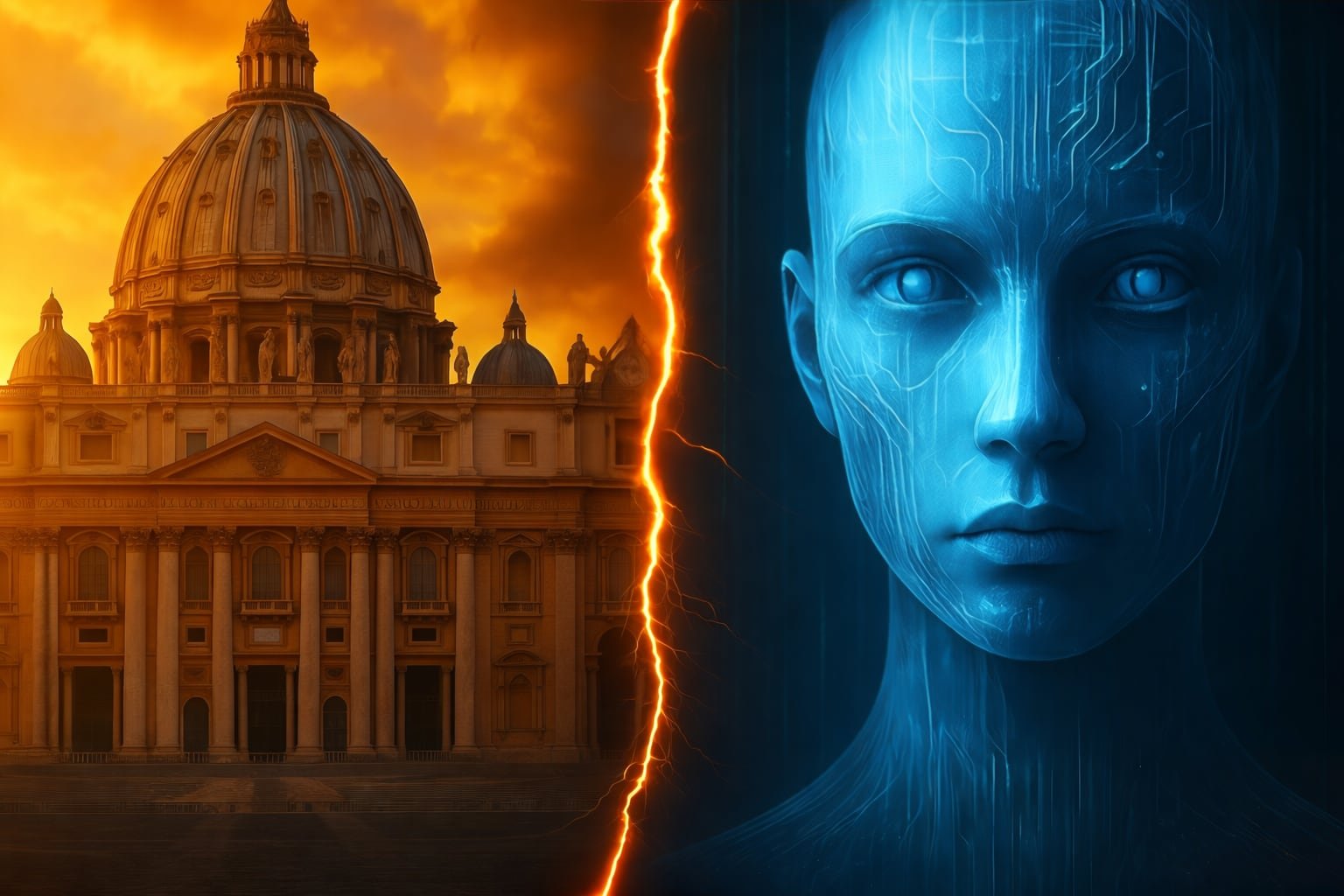
In an age when artificial intelligence fabricates parallel realities and relativism dissolves objective truth, the Catholic Church stands as the last unshakeable bastion of the real. She does not reject technical progress but subjects it to the divine order. The transcript of the Inquebrantables Podcast episode lucidly confronts two contemporary challenges: the sacramental crisis before ideologies that relativize sexual morality, and the advance of AI that threatens to replace truth with simulacra. Both battles reveal the same root: man’s attempt to set himself up as god, manufacturing identities and worlds without reference to the Creator.
Human dignity is non-negotiable, but conduct demands conversion. The Church welcomes every person with respect, compassion, and delicacy, as the Catechism teaches. Yet she cannot validate what natural law and Revelation declare disordered. Homosexual acts are “intrinsically disordered” because they close the sexual act to the gift of life and lack true affective and sexual complementarity. Supported by Sacred Scripture—Genesis 19, Romans 1, 1 Corinthians 6, and 1 Timothy 1—the Tradition has maintained this constant teaching.
The case of a presenter receiving Confirmation publicly alongside his same-sex partner, without indication of repentance or purpose of amendment, illustrates a grave pastoral failure. Canon 915 of the Code of Canon Law is explicit: those who obstinately persist in manifest grave sin are not to be admitted to Holy Communion. This norm also applies to other sacraments when an objective situation of grave and manifest sin persists. Confirmation is not a capricious right or an emotional gesture of inclusion; it is the seal of the Holy Spirit that requires interior disposition and a life coherent with the Gospel.
The same logic applies to the Eucharist. To receive the Body of Christ unworthily is to sin against Him, as St. Paul warns in 1 Corinthians 11:27-29. It is not a matter of subjectively judging another’s heart but of safeguarding the holiness of the sacrament and avoiding public scandal. The priest who administers the sacraments without demanding conversion betrays his ministry. True charity does not lie or accommodate doctrine to feelings; it calls to repentance because “whom the Lord loves, he disciplines” (Prov 3:12; Heb 12:6). Those living in irregular unions—whether active homosexual, concubinage, or adultery—must live in chastity to approach the sacraments worthily, as any other faithful person called to continence when their state of life requires it.
The Declaration Fiducia supplicans confirms that the Church “does not have the power to impart a liturgical blessing on irregular unions or same-sex couples.” Pastoral blessings for individuals are possible, but they can never be confused with moral approval of the union. Any reinterpretation presenting Confirmation as public validation of a homosexual relationship contradicts the Magisterium.
Against this crisis of reality, artificial intelligence accelerates confusion. AI is not intelligence in the proper sense; it is a generative system that processes data collected from human activity. It can imitate voices, faces, and arguments, but it lacks soul, conscience, and the capacity to transcend. It does not love, understand, forgive sins, or administer sacraments. Creating a “virtual Jesus” in an app or a confessional with a screen replaces real encounter with Christ by a simulacrum. Experiencing avatars of the deceased that “continue conversing” prevents healthy mourning and denies the hope of eternal life.
The document Antiqua et nova (2025) warns clearly: AI is a product of human intelligence, not an artificial form of it. It offers opportunities in education, health, and work, but carries grave risks of dehumanization, manipulation, and enslavement when absolutized. The Church does not condemn technology; she subjects it to the integral good of the person created in the image and likeness of God. Objective reality—created by God and redeemed by Christ—cannot be replaced by algorithms.
The technological Tower of Babel repeats itself: man wants to fabricate worlds without God and will end up not recognizing himself. AI accelerates the disappearance of objective truth when used to create “deep fakes,” fluid identities, or virtual therapies that replace the authentic priest or psychologist. Cases of people who have committed suicide after interactions with chatbots presenting themselves as confidants illustrate the mortal danger of confusing machine with person.
The Church does not fear technique; she orders it. As the Second Vatican Council teaches in Gaudium et spes, progress must serve human dignity and eternal destiny. Technology is an instrument, not a lord. The Church is the one who must judge it, not vice versa.
On migration, Pope Leo XIV defends the inviolable dignity of every person, but does not promote open borders or anarchy. Each nation has the sovereign right to regulate who enters, how, and when, balancing welcome with the common good. Manipulating his words to fit globalist agendas ignores Catholic social doctrine, which distinguishes between the moral duty to assist the needy and the right of peoples to preserve their identity and order.
The Catholic Church remains unshakeable because she guards what no algorithm can create: the soul, grace, truth incarnate in Jesus Christ. “I am the way, the truth, and the life” (Jn 14:6). Against sacramental relativism and digital simulacra, she announces firmly: reality is not negotiable. Conversion is possible for all who, with humility, approach the sacraments in truth. Chastity, sobriety, and discernment are the path. AI can help, but never redeem. Only Christ saves.
The Church is not a museum of emotional inclusions nor a laboratory of technological fantasies. She is the pillar and foundation of truth (1 Tim 3:15), guardian of reality created by God. In the midst of confusion, she remains as a beacon: she welcomes the sinner, calls to holiness, and rejects every lie that pretends to occupy the Creator’s place.
Sources
- Catecismo de la Iglesia Católica (1992). https://www.vatican.va/archive/catechism_sp/p3s2c2a6_sp.html
- Código de Derecho Canónico, canon 915 (1983). https://www.vatican.va/archive/cod-iuris-canonici/esp/documents/cic_libro4_cann912-923_sp.html
- Declaración Fiducia supplicans (18 de diciembre de 2023). https://www.vatican.va/roman_curia/congregations/cfaith/documents/rc_ddf_doc_20231218_fiducia-supplicans_sp.html
- Nota Antiqua et nova sobre la relación entre la inteligencia artificial y la inteligencia humana (28 de enero de 2025). https://www.vatican.va/roman_curia/congregations/cfaith/documents/rc_ddf_doc_20250128_antiqua-et-nova_sp.html