
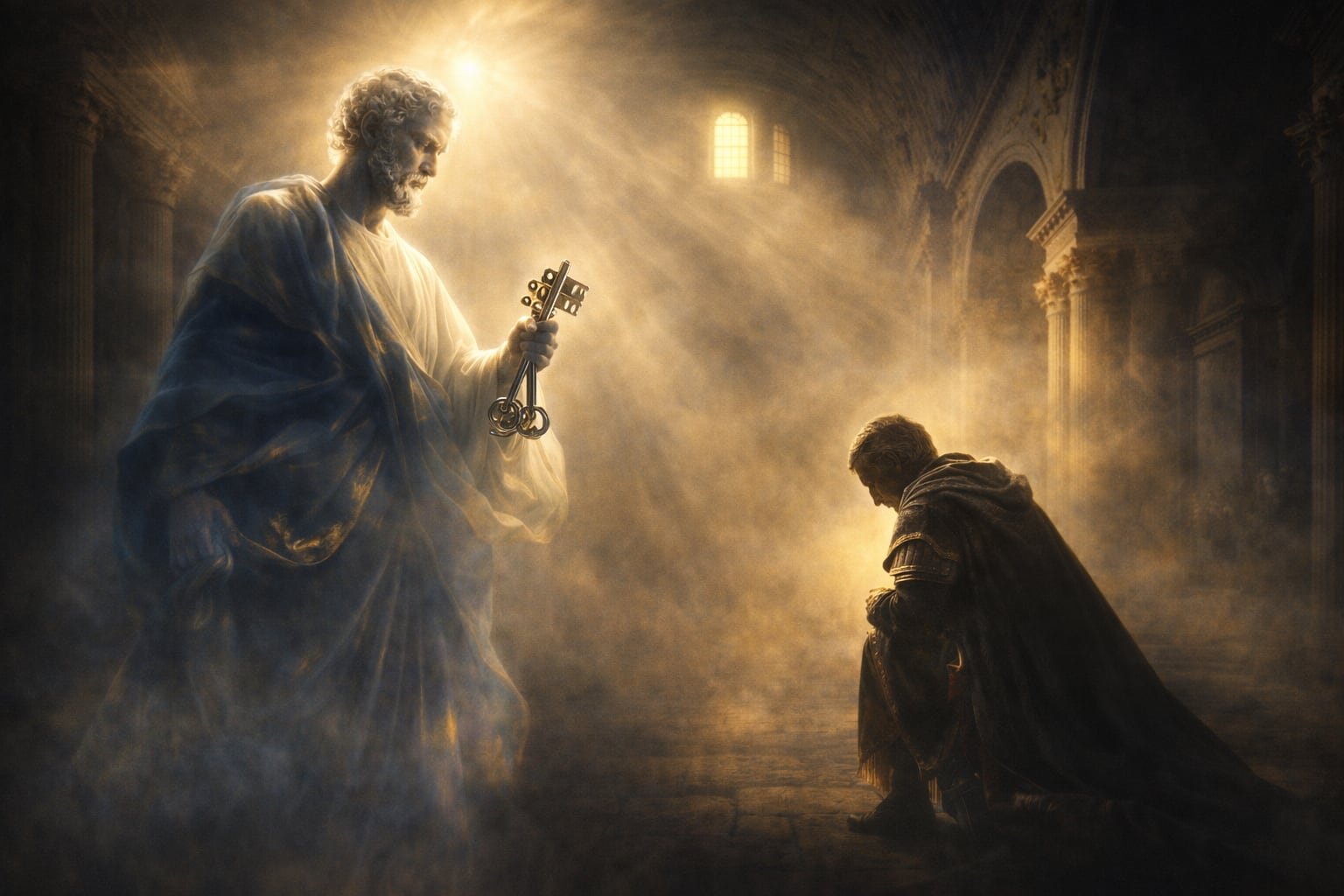
The Catholic Church was not born in the fourth century by imperial decree. It was born on the day of Pentecost, when the Holy Spirit descended upon the apostles gathered around Peter. I already wrote an article about this subject in this blog. Claiming that Constantine founded it is a historical and theological fallacy repeated by certain Protestant sectors to justify their own separation. As Father Tomás Agustín Beroch, Catholic priest, professor of philosophy and apologist, clearly and firmly explains in his April 14, 2026 post on X, this accusation collapses before biblical, patristic and historical evidence.
Cuando un sectario me dice que la Iglesia Católica la fundó Constantino, me regocijo y me mato de risa. No todos los protestantes son sectarios, algunos son buena gente. Pero este tipo de evangélicos que se la pasan atacando a la Iglesia Católica son muy chistosos. Deben… https://t.co/yFDynwpA9K
— Padre Tomas Agustin Beroch (@PadreTomasB) April 14, 2026
The Lie That Seeks to Justify a Break
The thesis that Constantine founded the Catholic Church does not appear in any document between the fourth and tenth centuries. No author of that period—Catholic or pagan—makes such a claim. It is a modern invention designed to delegitimize the apostolic continuity of the one Church founded by Christ. Father Beroch openly challenges the detractors: present a single written testimony from that period that supports such nonsense. The silence is absolute because the lie has no foundation.
Constantine Was Never Catholic
First, Constantine never belonged to the Catholic Church. He initially favored Christians but later persecuted them. He never received Catholic baptism. On his deathbed he was baptized by the Arian bishop Eusebius of Nicomedia with a non-Trinitarian rite, invalid according to Catholic faith. A man not baptized in the Church cannot found it. The Catechism of the Catholic Church teaches clearly: “The Church is the people whom God gathers in the whole world. It is born from the design of loving humanity from its origin” (CCC 761). That design is fulfilled in Christ and the apostles, not in a Roman emperor.
The Edict of Milan: Freedom, Not Foundation
The Edict of Milan (313) only granted freedom of worship to Christianity. It did not declare it the official religion of the Empire—that was Theodosius in 380—nor did it create any ecclesial structure. Comparing it to Nebuchadnezzar’s edict in the Book of Daniel is precise: a pagan monarch allows the faith without becoming its founder. No one claims Nebuchadnezzar founded Judaism. Why then claim Constantine founded the Church? The biblical analogy dismantles the argument using the very Scripture that Protestants claim to defend.
Liturgical Language and the See of Peter
Nor does the adoption of Latin prove any foundation. The Church was born in Palestine and used Greek in its first centuries because it was the lingua franca of the Empire. It later adopted Latin for practical reasons, not doctrinal ones. The 24 Eastern rites of the Catholic Church preserve their own languages without anyone questioning their catholicity. Regarding the see: Peter received the keys of the Kingdom from Christ (Mt 16:18-19). Although the Church began in Jerusalem under James, Peter ended his ministry in Rome as visible head. The Church does not lose its apostolic identity by changing its geographic center, just as the chosen people did not cease to be so when they left Ur of the Chaldees.
The Council of Nicaea and the Title of Pontiff
Constantine convened Nicaea (325), but he did not intervene in its dogmatic decisions. The bishops, under papal authority, condemned Arianism. The emperor submitted to the Church, not the other way around. Nor did he adopt “Roman Pontiff” in the spiritual sense: that title already belonged to the successor of Peter. Saint Cyprian, one hundred years before Constantine, wrote in De Unitate Ecclesiae that whoever is not united to the Chair of Peter is not in the Church. Apostolic succession already existed.
The Alleged Constantinian Corruption
The gravest accusation claims that Constantine corrupted the early Church and that Protestants had to “reform” it. This directly contradicts Christ’s promise: “The gates of hell shall not prevail against it” (Mt 16:18). The Catholic Church is the only one that has not modified its dogmas in two thousand years. Protestantism, by contrast, has changed doctrines on divorce, the Eucharist and even natural marriage. Doctrinal continuity is the seal of the Church Christ founded and protects.
Pagan Elements: Christianization, Not Syncretism
Nor was the Church corrupted by Christianizing pagan customs. Missionaries took cultural symbols to elevate them toward Christ, as with the feast of the unconquered sun turned into Christmas, showing that the true Sun of Justice is the Lord. It was the pagans who imitated Catholic rites to retain followers, not the other way around. Doctrinal purity remained intact.
The Creed and True Foundation
The name “Nicene-Constantinopolitan” does not honor Constantine as founder, but the cities where the councils were held. Just as the Church of Alexandria was not founded by Alexander the Great. The Creed is the fruit of apostolic faith guarded by the bishops, not of an emperor who died in the Arian heresy.
As Father Beroch rightly concludes, whoever needs to invent historical lies to justify his existence demonstrates precisely the fragility of his position. The Catholic Church is the one Christ founded upon Peter and that the Holy Spirit guides until the end of time.
Sources
- Father Tomás Agustín Beroch (@PadreTomasB). “When a sectarian tells me that Constantine founded the Catholic Church…”. X, April 14, 2026. https://x.com/PadreTomasB/status/2044017165582409868
- Holy Bible (Catholic version, 73 books). Matthew 16:18-19; Romans 13:1-7; Daniel 3.
- Catechism of the Catholic Church (1992). nn. 751-756, 761-766.
- Saint Cyprian of Carthage. De Unitate Ecclesiae (251 A.D.).
- Council of Nicaea I (325). Conciliar acts.
- Edict of Milan (313) and Theodosian Code XVI,1,2 (380).