

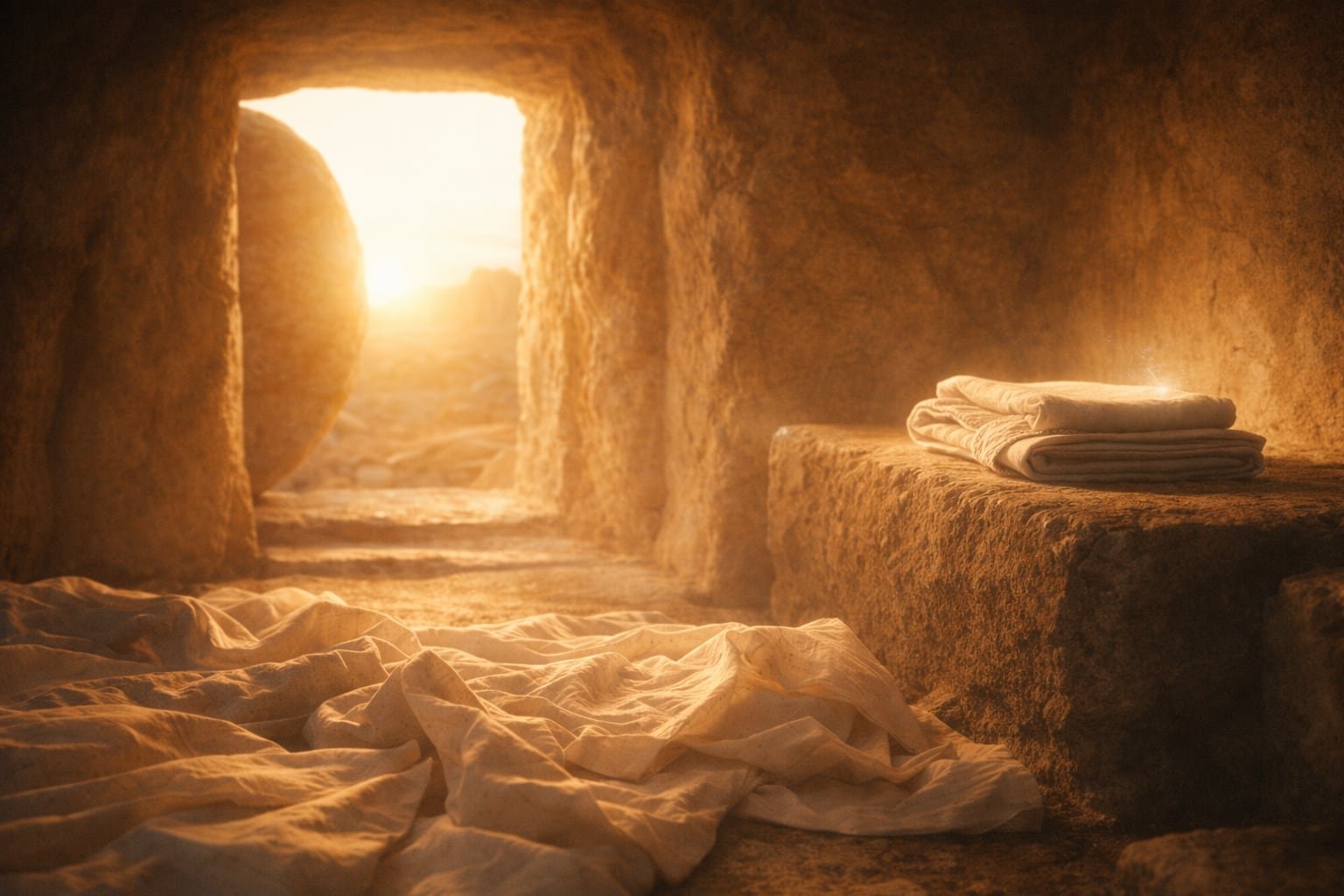
Today is a day of ineffable glory: Christ is risen! Truly He is risen! Death has been conquered, hell despoiled, and the tomb emptied. Amid this central truth of our faith, the Gospel of John delivers a seemingly minor yet theologically profound detail: the cloth that had covered Jesus’ head was not lying disordered with the other linens, but rolled or folded in a place by itself (Jn 20:7).
This intentional, serene, and orderly gesture is no accident. It speaks of the majesty of the Risen One, His tranquil victory over death, and – in Christian piety – evokes the certainty that His redemptive work is not finished. He will return.
The Gospel Account: A Detail That Awakens Faith
John, an eyewitness, narrates with precision: Peter enters the tomb and sees the linens on the ground; then he notices the sudarium that had been on the Lord’s head, “not lying with the linen cloths but rolled up in a place by itself” (Jn 20:7). The Greek verb entetyligménon indicates a careful, deliberate folding – not the chaos of theft or hasty abandonment.
This order violently contrasts with what thieves or profaners would leave behind. No one stealing a body would pause to fold the face cloth neatly. The detail reveals calm, sovereign control, and divine dignity. John, upon seeing it, “saw and believed” (Jn 20:8). He had not yet seen the Risen Lord in the flesh, yet he contemplated the signs of His victorious passing and his faith was kindled.
The Popular Tradition of the “Folded Napkin”: Beauty and Historical Precision
A widespread pious interpretation holds that, in ancient Jewish table custom, if the master finished eating he would crumple the napkin and toss it (signaling “I am finished”), but if he folded it neatly and set it aside, it meant “I am not finished; I will return.” Applied to the sudarium, Jesus would be telling His disciples: “My work is not complete; I will return.”
This anecdote is beautiful and has nourished the hope of generations. However, rigorous historical and exegetical analysis in Catholic sources shows no documentary evidence for such a custom in first-century Judaism in the Holy Land. Serious studies, including respected Protestant and Catholic commentaries, regard it as a pious urban legend without foundation in rabbinic literature or period practices. The soudárion was a face cloth, not a table napkin, and the tomb was not a banquet.
Nevertheless, while the specific anecdote lacks strict historical basis, the spiritual sense the faithful have drawn from it is profoundly Catholic and legitimate in the analogical reading of Scripture. By leaving the cloth folded with care, the Risen Lord manifests that death did not hold Him, that His victory is serene, and that His redemptive mission continues until He comes again in glory.
The True Doctrinal Meaning: Victory, Order, and Eschatological Hope
The Catholic Church, faithful to Sacred Scripture, Tradition, and the Magisterium, reads this passage in the light of all Revelation. The folded sudarium underscores inseparable mysteries:
- The bodily reality of the Resurrection. It was neither theft nor ethereal vision. Jesus’ body rose glorious yet real. The empty linens and ordered cloth prove it. As the Catechism of the Catholic Church teaches: “The Resurrection of Jesus is the culminating truth of our faith in Christ” (CCC 638).
- Divine serenity confronting the chaos of death. Death is disorder, corruption. The Risen One leaves everything in perfect order.
- The promise of His return. Though the “napkin tradition” is not historical, the entire New Testament resounds with the certainty of the Lord’s return: “This Jesus who has been taken up from you into heaven will come in the same way as you saw Him go into heaven” (Acts 1:11). The folded cloth, in the Church’s spiritual reading, reminds us that Christ’s work – the redemption of the world – will be fully consummated at His Second Coming.
The Catechism states clearly: “We firmly believe, and hence we hope, that just as Christ truly rose from the dead and lives forever, so the just after death will live forever with the risen Christ” (CCC 989).
Confrontation with Contemporary Errors
Against those who reduce the Resurrection to myth, symbol, or “spiritual awakening,” the Church firmly defends the historicity of the empty tomb and the corporeality of the Resurrection. Against a lightweight Christianity that forgets the Parousia, this detail confronts us: Christ has not finished His work. The Church is not a social club but the Body of the Lord awaiting its Bridegroom vigilantly.
We do not attack persons, but we dismantle ideas contrary to the faith: relativism denying the objective truth of Easter, materialism ridiculing miraculous signs, and any interpretation emptying the Resurrection of eschatological content.
Conclusion: Today, Like John, “He Saw and Believed”
On this holy day, let us contemplate the folded burial cloth – not as folk proof of a non-existent custom, but as a powerful sign of Christ’s victory: order amid the tomb, life where death reigned, and a silent promise that the Master will return.
May Mary, faithful witness of the Passion and glory of her Son, obtain for us the grace to live this Easter with ardent faith, vigilant hope, and active charity. For Christ is risen – and He will come again. Maranatha! Come, Lord Jesus!
Sources and Doctrinal References
- Holy Bible (Catholic edition with 73 books), Gospel of John 20:6-8.
- Catechism of the Catholic Church, nn. 638-658 (The Resurrection of Christ), 989-1004 (The Resurrection of the Dead). Available at: https://www.vatican.va/archive/ENG0015/_INDEX.HTM
- Patristic and modern exegetical commentaries on Jn 20:7 (St. Augustine, Tractates on the Gospel of John; Catholic works such as the Navarre Bible).