
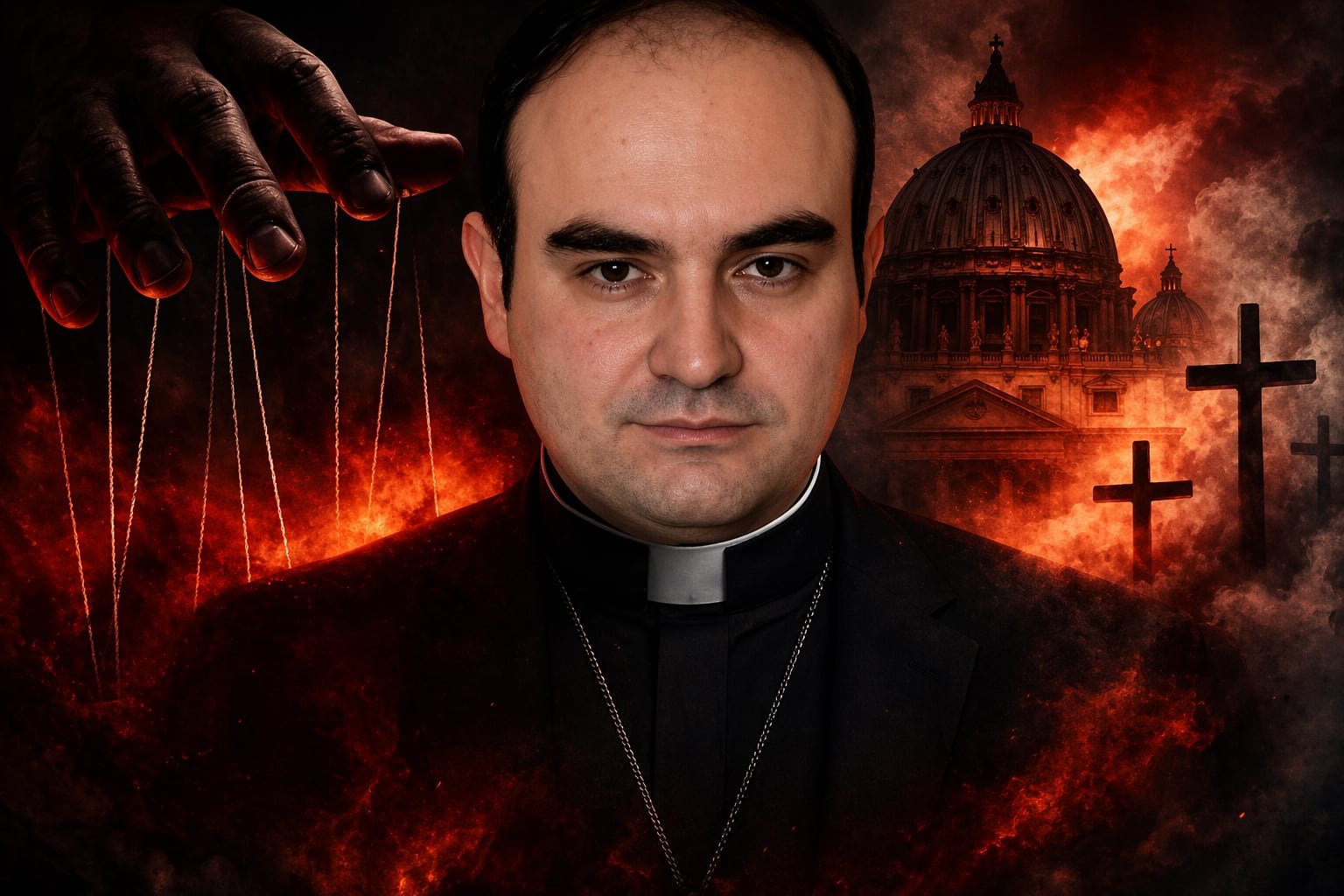
The Church of Christ is enduring a profound confusion that many prefer to avoid confronting. While external enemies are loudly denounced, the deepest crisis arises from within: a loss of doctrinal clarity that multiplies external chaos. Mercy is confused with relativism, pastoral care with ambiguity, and dialogue with renunciation of truth. This is not a superficial debate but the mature fruit of modernism — that “synthesis of all heresies” condemned by St. Pius X. Today, as then, it threatens to deform the very mindset of Catholics and subject the deposit of faith to the changing dictates of the age.
Modernism: The Synthesis of All Heresies and the Deformation of the Catholic Mind
Modernism is not merely a matter of external adaptations or updating the faith to modern times. St. Pius X defined it with precision in the encyclical Pascendi Dominici Gregis (1907) as the synthesis of all heresies — not a single error, but a collector that gathers and unites every previous deviation. It replaces objective, stable truth — independent of opinions or cultural context — with a fluid truth shaped by subjective perception or historical circumstances. When truth becomes flexible, morality, doctrine, and even language become negotiable.
“Grant us, O merciful God, to desire always what is pleasing to You, to investigate it prudently, to recognize it truthfully, and to fulfill it perfectly, for the praise and glory of Your name.” This prayer of St. Thomas Aquinas captures the authentic Catholic spirit: truth does not adapt to the world; the world must be interpreted in the light of revealed truth. Modernism inverts this order and transforms the mental categories of the faithful, so that they contemplate both the internal and external reality of the Church in a distorted manner.
The error did not die with St. Pius X’s vigorous condemnation. It evolved into what was later called the “new theology” and achieved its triumph in the post-Vatican II period. Far from disappearing, it has infiltrated pastoral practice, academic theology, and ecclesiastical language, producing ambiguity where clarity once reigned. Many Catholics of good will, without realizing it, now think according to patterns that derive not from Tradition but from modern ideologies.
Masonic Infiltration and the Transformation of Catholic Thinking
Freemasonry is not simply a philanthropic society. From its origins it carried the clear intention of destroying the Catholic social order to establish a new order founded on deism and the relativization of truth. The Church recognized the danger immediately: Pope Clement XII condemned it in 1738 with the bull In Eminenti, imposing excommunication.
Today the infiltration is not only material — concrete members inside the Church — but especially formal and far more dangerous: Masonic thought has changed the mindset of many Catholics who, without being formal members, reason like Masons. Truth is relativized, doctrine is diluted, and the language of the world is adopted. The great victory of Freemasonry lies precisely in the fact that it no longer needs strict secrecy; its principles circulate openly in political parties, publishing houses, and even certain ecclesiastical circles under the appearance of progress or dialogue.
A faithful Catholic must learn to distinguish between legitimate pastoral development and the distortion of the faith. The former illuminates circumstances with the perennial light of the Gospel; the latter subjects the Gospel to circumstances. The difference lies in fidelity to the deposit of faith. As Christ taught regarding the scribes and Pharisees: “Do what they say, but do not do what they do” (Mt 23:3), because they speak from the chair of Moses. Truth does not depend on the personal morality of the one who proclaims it.
Abortion and Capital Punishment: Moral Distinctions That Cannot Be Erased
One of the clearest signs of this confusion is the frequent equating of abortion and the death penalty. Both involve the taking of human life, yet they do not share the same moral nature. Abortion is the direct and intentional killing of an innocent human being — an abomination contrary to the Fifth Commandment rightly understood as “You shall not commit murder” against the innocent. The Catechism states unequivocally: “Human life must be respected and protected absolutely from the moment of conception” (CCC 2270). Direct abortion is gravely immoral and incurs automatic excommunication.
Capital punishment, by contrast, is inflicted upon a guilty person after a just trial. The long tradition of the Church, grounded in natural law and sustained by the Magisterium for centuries, considered it a legitimate extreme means of defending the common good, analogous to individual or collective self-defense. It is not vengeance but protection of society from a grave internal aggressor. Equating the two realities insults intelligence and commits injustice against the innocent — especially the unborn, the most defenseless of all.
The modification introduced in CCC 2267 by Pope Francis emphasizes that, in present circumstances, the death penalty is inadmissible because it attacks human dignity. However, this judgment refers to concrete historical conditions and does not abolish the traditional doctrine regarding the moral possibility of capital punishment in principle, when it would be the only effective means to defend the common good. The essential distinction between innocent and guilty remains intact; erasing it produces a relativized moral conscience that eventually justifies the unjustifiable.
Partisan “Hooliganism” and the Dictatorship of Relativism
The crisis deepens with political “hooliganism”: Catholics divide into opposing camps — left or right, liberal or conservative — and apply moral judgments selectively according to partisan affinity. One violence is condemned while another is justified; certain abuses are denounced while others are silenced. This is not Catholic moral judgment but tribal positioning. The Catholic must submit every system — communism, fascism, liberalism, and flawed democracies — to the light of natural law and the Gospel. No “lesser evil” can be turned into an idol.
Benedict XVI prophetically warned of the “dictatorship of relativism.” Truth does not adapt to context; context is judged in the light of truth. Faith and reason are not opposed; they are “like two wings on which the human spirit rises to the contemplation of truth” (Fides et Ratio). Faith illumines and perfects reason; reason, subordinated to faith, demonstrates that our religion is the most reasonable of all.
When language ceases to serve truth and is placed at the service of ever-changing narratives or political messianisms, society loses its capacity for discernment. The true is confused with the convenient, and even the innocent pay the price. The Church cannot remain silent before war, crimes against life, or any attack on human dignity. Her voice must be prophetic, not diplomatically diluted.
A Call to Conversion and Fidelity
The Church Militant is on the way of perfection, filled with sinners in need of mercy. No one may disqualify truth because of the past sins of the one who proclaims it; otherwise neither St. Paul nor St. Augustine could have taught. Sincere conversion gives glory to God. What matters is objective truth, not a media image of perfection.
Faced with modernism, Masonic infiltration, moral confusion, and partisan spirit, Catholics are called to recover the traditional Catholic mindset: doctrinal clarity, precise distinctions, and obedience to revealed truth. This is not nostalgia but fidelity to the deposit of faith guarded by the Church since the Apostles.
May the Blessed Virgin Mary, Mother of the Church, intercede so that today’s Catholics are not deceived. May the Lord grant us always to desire what pleases Him, to recognize it truthfully, and to fulfill it perfectly.
Sources
- St. Pius X, Encyclical Pascendi Dominici Gregis, 8 September 1907. https://www.vatican.va/content/pius-x/en/encyclicals/documents/hf_p-x_enc_19070908_pascendi-dominici-gregis.html
- Clement XII, Bull In Eminenti, 1738.
- Catechism of the Catholic Church, nn. 2270-2272 (abortion) and 2267 (death penalty, new wording).
- St. John Paul II, Encyclical Fides et Ratio, 14 September 1998. https://www.vatican.va/content/john-paul-ii/en/encyclicals/documents/hf_jp-ii_enc_14091998_fides-et-ratio.html
- Sacred Scripture (Mt 23:2-3; Ex 20:13).