
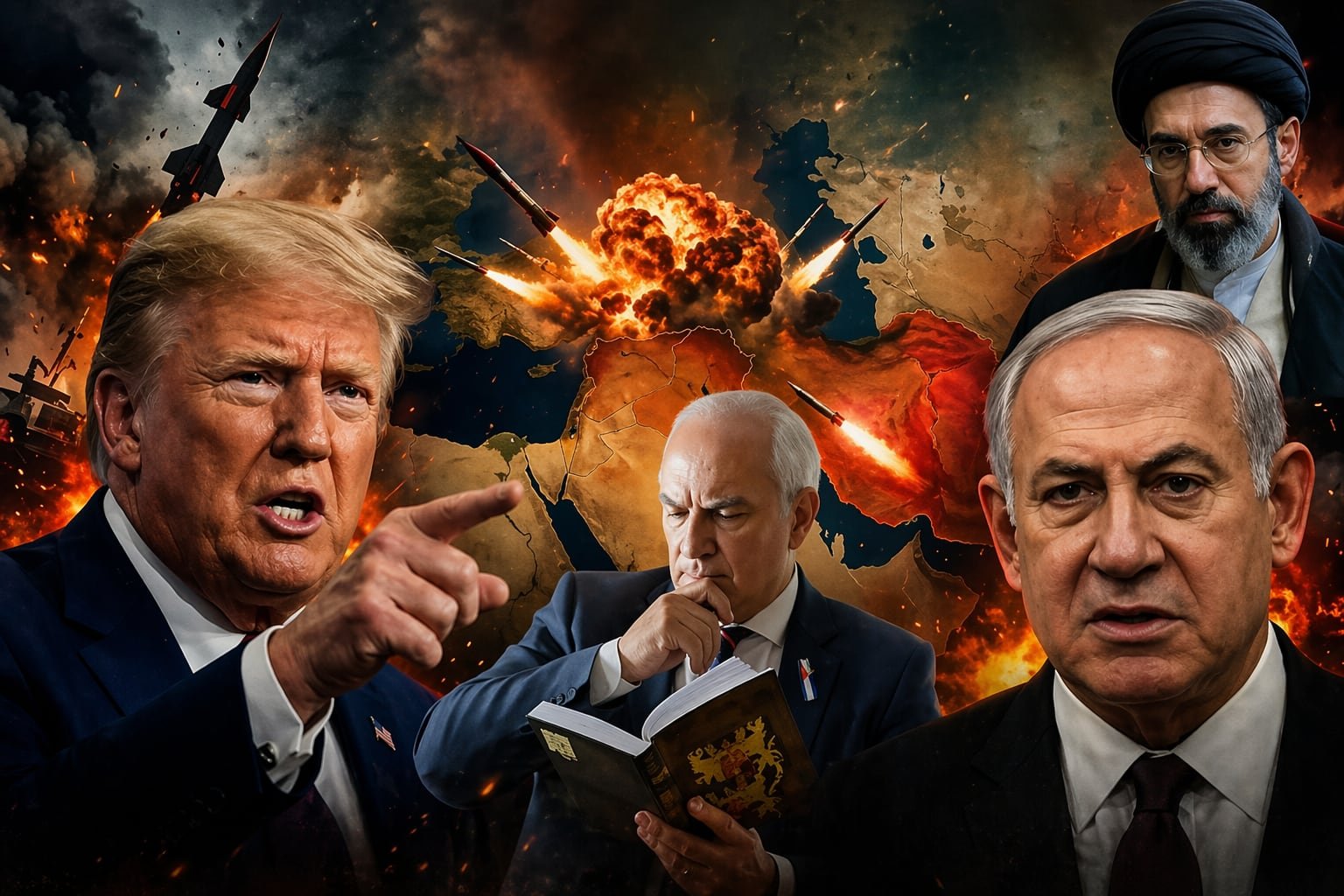
The current military escalation between the United States, Israel, and Iran is not merely a geopolitical conflict over resources or territory. It is a confrontation in which strategic reason has dangerously divorced itself from Christian morality, opening the door to a tragedy of biblical proportions. As Catholics, we cannot analyse it with materialistic coldness: war affects concrete bodies, immortal souls, and the eternal destiny of nations.
The Separation Between Reason and Morality: A Grave Error
Many analysts claim that morality is a naive adornment in war strategy. This idea, repeated in certain circles, is false and dangerous. Reason and morality do not belong to separate planes; morality is a constitutive dimension of human reality. Reducing war to pure strategic calculation ignores its effects on persons of flesh and blood, becoming idealism disguised as realism.
The Catechism of the Catholic Church states clearly: “War, unfortunately, is one of the consequences of sin” (CCC 2314). The Church has always distinguished between just and unjust war, demanding proportionality, discrimination between combatants and non-combatants, and last resort. Bombing a girls’ school in Minab (Iran) on February 28, 2026, causing over 168 deaths —mostly girls aged 7 to 12—, gravely violates these principles. Satellite images and independent verifications confirm the double missile strike, which also hit rescuers. Such acts do not defend civilization; they destroy it from within.
Monsignor Fulton Sheen, in his famous reflection on Hiroshima and Nagasaki (1945), pointed to the moment when the West broke moral limits: “That day they erased the boundaries between civilian and military, between wounded and helper, between living and dead.” Since then, culture has cried out “I want to be myself without limits.” Today we repeat the error in Iran.
The Religious and Civilizational Character of the Conflict
Historian and Catholic Hispanist Professor Patricio Lons explained it lucidly: ancient wars were for territory; modern ones, for markets. Now we enter a theological phase, for faith itself. Iran is not a monolithic Islamic bloc. Its Persian and Shia tradition preserves elements allowing coexistence with Christian and Jewish minorities, as evidenced by the “Holy Virgin Mary” metro station inaugurated in Tehran in 2025, with Marian iconography and religious authorities present. This would be unthinkable in other Wahhabi contexts.
In contrast, the Talmudic or vengeful Protestant mindset —eye for eye without the evangelical corrective of forgiveness— fuels cycles of retaliation. Jesus Christ did not come to abolish the law, but to perfect it: “You have heard that it was said eye for eye… but I say to you: do not resist the evil one” (Mt 5:38-39). Christianity introduces mercy without renouncing justice.
Hispano-American history teaches us that Catholic unity enabled flourishing trade with Persia in the 17th-18th centuries via the Manila Galleon. Independence, partly driven by British interests, fragmented that world and opened the way for later dominations. Today, as then, external powers sow division while ignoring their own hypocrisy: the United States with millions of homeless and a fentanyl crisis, or the destruction of heritage like Montecassino or Dresden in World War II.
Eschatological Risks: The Third Temple and the False Messiah
It is not only geopolitics. The escalation may pave the way for the reconstruction of the Third Temple in Jerusalem, a project pushed by some Zionist and Protestant dispensationalist sectors. This would constitute an explicit rejection of Christ’s unique sacrifice: “For by one offering he has perfected forever those who are sanctified” (Heb 10:14). Returning to animal sacrifices would be spitting on the New Testament.
The Apocalypse warns of a false prophet and a temporal dominion that will seduce the nations (Rev 13). Prophetic characteristics speak of a charismatic figure of dark birth who will unite political and religious powers. Faced with famine from fertilizer disruption, energy shortages, and chaos, many will accept “the mark” for survival. Catholics must remember: “Let the one who has understanding calculate the number of the beast” (Rev 13:18). The solution is not panic, but spiritual vigilance.
The Jesuits who survived Hiroshima, praying the Rosary daily, emerged unscathed from the epicenter. The Virgin Mary, whom Iran itself honors in its metro, intercedes. Her Immaculate Heart will triumph, as promised at Fatima.
A Call to Conversion and Prayer
This war will not destroy only Iran or Israel; it corrodes the soul of the West, which has renounced its Christian roots and now believes in anything: horoscopes, ideologies, or absurd “self-perceptions.” Man without God ends up justifying any crime in the name of survival or “security.”
As Catholics, we defend reason illuminated by faith. We reject the relativism that changes justifications according to the side: burqas one day, women’s rights another, weapons of mass destruction the next. Truth does not change.
Let us pray with the prayer that opens the podcast: “Father of love and mercy, you who make the tongue of children eloquent, educate mine also.” Let us pray the Rosary for peace, for the victims —girls of Minab, soldiers, civilians—, and for the conversion of leaders who start wars.
The Catholic Hispanidad, heir to the tercios and Romanity, has a mission: to resist in small faith communities, sow, defend one another, and await the second coming of Christ the King. Let us not fear; God plays better than any strategist.
Sources
- Catecismo de la Iglesia Católica (1992). Librería Editrice Vaticana. https://www.vatican.va/archive/catechism_sp/index_sp.html
- Sagrada Biblia, versión oficial de la Conferencia Episcopal Española (73 libros).
- Fulton J. Sheen, sermones sobre Hiroshima y los límites morales (1940s-1970s).
- Patricio Lons, canal “Historia con Patricio Lons” en YouTube (análisis histórico-hispanista). https://www.youtube.com/channel/UCa81SE6SxNsANTHs8wyztvg
- Johana Montenegro, artículo “Estados Unidos, Israel e Irán: cuando colapsan la razón y la moral”, republicosvenezuela.org.
- Reportes verificados sobre el ataque a la escuela Shajareh Tayebé en Minab (BBC, HRW, 2026).
- Inauguración estación metro “Santa Virgen María”, Teherán (2025), EFE y medios católicos.