
The Narrative of Saint Matthew and the Presence in Bethlehem
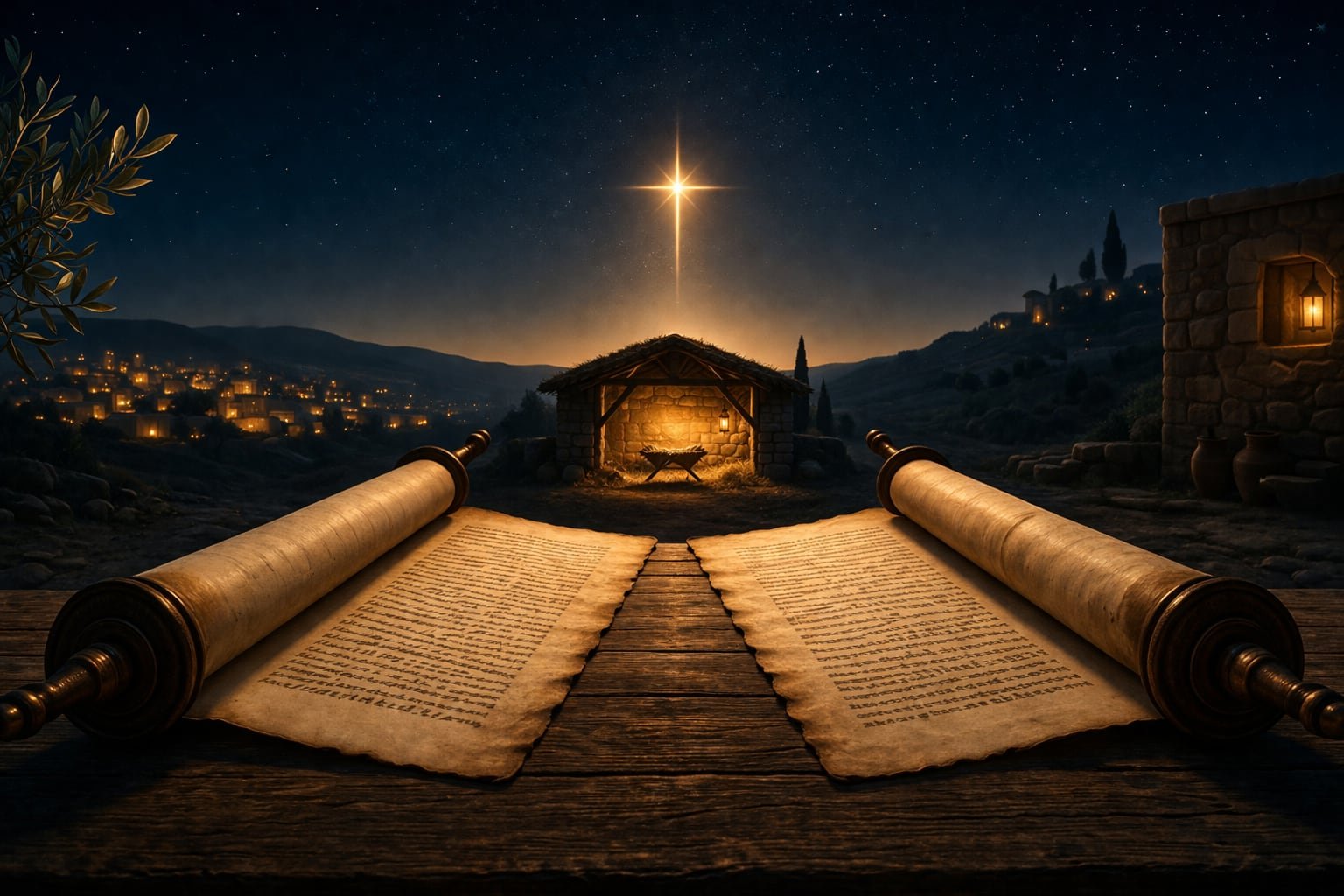
The Gospel according to Saint Matthew presents the birth of Jesus in Bethlehem of Judea as a central fact fulfilling the prophecy of Micah: “And you, Bethlehem, land of Judah, are by no means least among the rulers of Judah, for from you shall come a ruler who will shepherd my people Israel” (Mt 2:6; cf. Mic 5:1). The text mentions that the Magi entered “the house” where the Child was (Mt 2:11). This reference has led some to suppose that the Holy Family already resided there permanently before the flight to Egypt. However, Matthew does not explicitly affirm a prior permanent residence; his account focuses on messianic fulfillment and Christ’s kingship, threatened by Herod. The Jewish evangelist emphasizes prophetic continuity and divine sovereignty against earthly power, without dwelling on secondary chronological details.
Saint Luke’s Account and the Journey from Nazareth
Saint Luke, for his part, provides a more detailed historical Roman context: Joseph, “of the house and family of David,” travels from Nazareth in Galilee to Bethlehem in Judea “to be enrolled with Mary, his betrothed, who was with child” (Lk 2:4-5). The census ordered by Augustus explains the temporary displacement. Luke does not mention a house of their own in Bethlehem nor a prolonged stay; instead, he describes the birth in a manger because there was no room in the inn (Lk 2:7). After the purification in the Temple, the evangelist summarizes: “When they had fulfilled all the prescriptions of the Law of the Lord, they returned to Galilee, to their own town of Nazareth” (Lk 2:39). Here lies the apparent tension: how to reconcile Matthew’s “house” with Luke’s return to Nazareth?
The Complementarity of the Gospels under the Inspiration of the Holy Spirit
There is no contradiction. The two accounts complement each other in perfect harmony because both were written under the same divine inspiration. Saint Matthew selects the events that manifest Jesus as the Messiah-King for a Jewish audience; Saint Luke, a physician and historian, offers the chronological and universal framework for Gentiles. The Holy Family ordinarily lived in Nazareth, but Joseph, a Davidic descendant, had to register in Bethlehem, his ancestral city, because of the census. The “house” mentioned by Matthew does not imply prior permanent residence but the place where they were staying during those days—possibly family lodging or temporary quarters. The events of the Magi and the flight to Egypt took place while the Family was still in the region of Judea, before the definitive return to Nazareth. Saint Joseph, warned in a dream, avoids Judea after Herod’s death and settles in Nazareth “so that what had been spoken through the prophets might be fulfilled: He shall be called a Nazorean” (Mt 2:23). Thus, Luke summarizes the final return and Matthew details the intervening events. This harmonious reading is the one upheld by Tradition since the Church Fathers.
The Magisterium’s Teaching on the Inerrancy of Sacred Scripture
The Catholic Church clearly affirms that the Gospels contain no error in what they assert for our salvation. The Catechism of the Catholic Church teaches: “Since therefore all that the inspired authors or sacred writers affirm should be regarded as affirmed by the Holy Spirit, we must acknowledge that the books of Scripture firmly, faithfully, and without error teach that truth which God, for the sake of our salvation, wished to see confided to the sacred Scriptures” (CCC 107). This doctrine is grounded in the Dogmatic Constitution Dei Verbum of the Second Vatican Council, which declares: “The books of Scripture teach firmly, faithfully and without error that truth which God wanted put into sacred writings for the sake of salvation” (Dei Verbum, 11).
Saint Augustine, in his work De consensu evangelistarum, already resolved such supposed discrepancies by showing that the evangelists, guided by the same Spirit, choose, arrange, and present the facts according to each one’s theological purpose, without ever contradicting one another. The apparent difficulty arises only when a modern criterion of exhaustive biography and absolute chronology is imposed on the text, foreign to the literary genre of the Gospels and to the divine design.
Conclusion: Defense of Biblical Truth
Far from being a contradiction, the narratives of Matthew and Luke are eloquent testimony to the wisdom of the Holy Spirit, who inspires the sacred writers to transmit, each according to his charism, the one saving truth: the Word became flesh in Bethlehem, grew in Nazareth, and is the Savior of the world. Whoever seeks to find error in the Word of God forgets that “all Scripture is inspired by God and is useful for teaching” (2 Tim 3:16). The Catholic faith does not fear scrutiny; on the contrary, it confronts it with the certainty that the Bible, read in the Church and with the Church, is inerrant.
Sources
Catechism of the Catholic Church 1992-1997 (typical Latin edition 1997) Catechism of the Catholic Church https://www.vatican.va/archive/ENG0015/_INDEX.HTM
Second Vatican Council 1965 Dogmatic Constitution Dei Verbum https://www.vatican.va/archive/hist_councils/ii_vatican_council/documents/vat-ii_const_19651118_dei-verbum_en.html
Holy Bible (Approved Catholic Editions) Various (approved editions) Holy Bible https://www.vatican.va/archive/bible/index.htm
Saint Augustine c. 400 A.D. De consensu evangelistarum (Harmony of the Gospels) https://www.augustinus.it/latino/consenso_evangelisti/consenso_evangelisti_2.htm